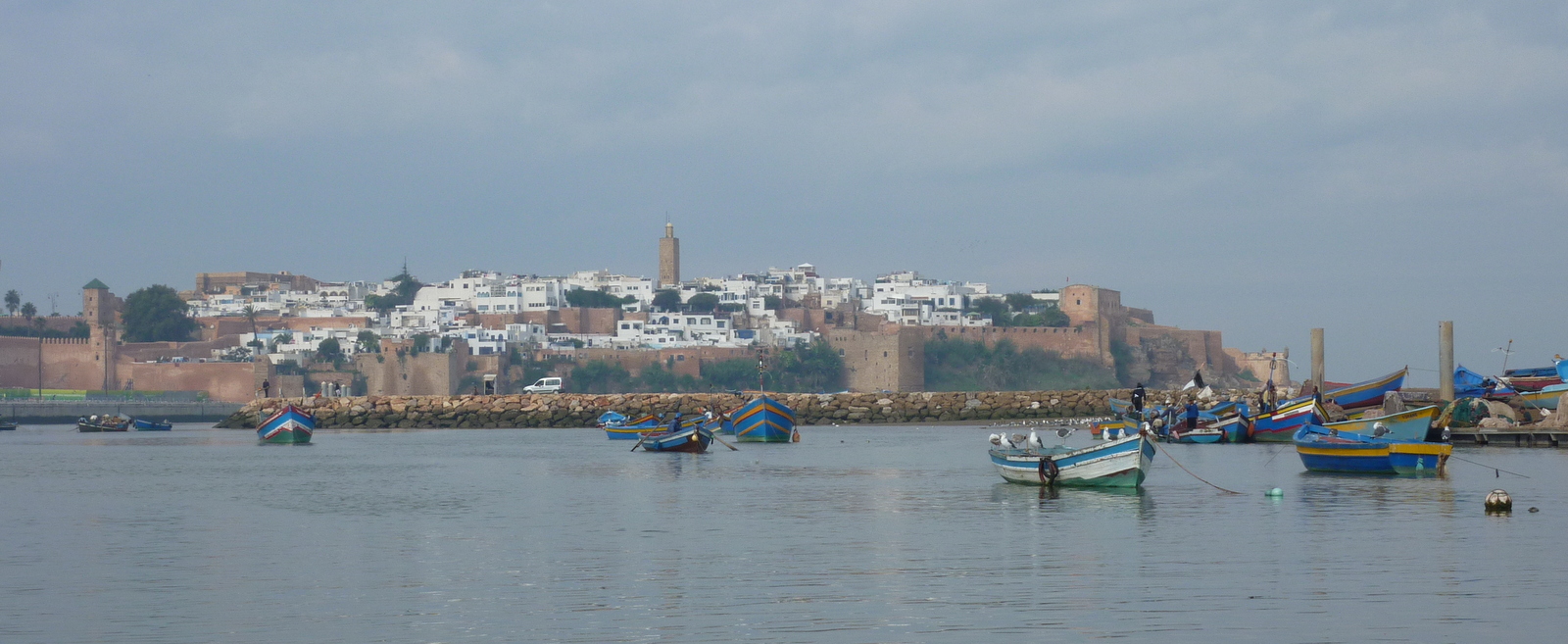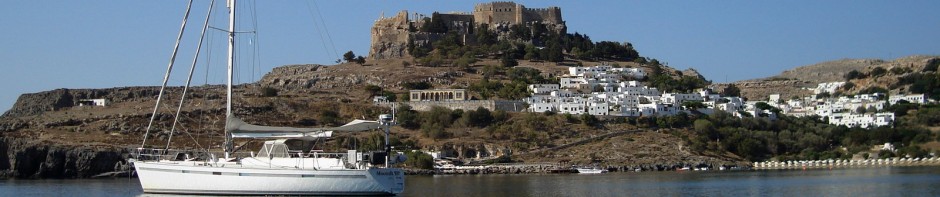
From the Turkish town of Cesme it was a short, eight-mile hop back to Greece and the island of Chios. We slipped away early in the morning before the mighty Meltemi began to blow and we found plenty of space to Med-moor on the quay in Chios town.
All the offices of officialdom were well hidden on the opposite corner of the harbor near the ferry terminal, more than a mile walk from where we were tied up. As usual, the officials were polite, professional and helpful, even if we did have to wait to meet the Customs officer for our transit log. Just before we finished the process, a power failure shut the place down. As if it were a daily occurrence, I was nonchalantly told I’d need to return in a few hours to finish the process. When something like this happens, all you can say is T.I.G. (This is Greece!)
The good news is that the Port Captain was kind enough to organize a mini tanker so we could bring Moonshadow to the quay near his office later in the day and top up the diesel tanks and avoid another two-mile walk. Armed with a new Greek Transit Log and a load of very expensive dinosaur juice (US $7 a gallon), we were ready to head west.
Chios town is pleasant, if a bit noisy from all the auto traffic, but lacks the quaint atmosphere of many of the small Greek port villages we visited in the Dodacanese and Cyclades. In other words, it’s not really a place we wanted to hang out.
A favorable weather window for crossing the Northern Aegean Sea was on the horizon, so we departed Chios and headed down the coast and anchored in a small bay off the village of Emborios near the southern tip of the island. The steep-walled, rocky inlet was rather tight quarters but picturesque. It afforded us reasonable overnight protection and was a good staging point for the first leg of our run across the Aegean.
Early the next morning we took advantage of the lull in the Meltemi and motor-sailed west about half way across the Aegean to Andros Island, the northernmost of the Cyclades group. We found good protection in the Gavrion Bay on the west side of the island. Andros is a rather quiet island which is largely off the tourist’s radar screen. Dotted with some lovely old homes, this fertile island remains primarily an agricultural area.
We were away early the next morning and hoped to cover some ground before the Meltemi piped up again, but by the time we reached Kea Island the wind and seas had whipped up and we were bashing into them. Fortunately, we were able to bear away to the south as we rounded the top of the island and we had a sleigh ride into Vourkari Bay. We had some difficulty getting our Bruce anchor to set in the weed bottom but finally managed to get properly hooked on the fourth attempt. We waited out another day of a strong Meltemi and were able to organize a berth at the Zea Marina in Piraeus.
Kea is a charming little island with a large, natural harbor with good all-around protection. Its close proximity to Athens makes it a popular destination for those wanting
to get away from the “big smoke” and its hills are dotted with expensive and expansive villas.
Departing early the next morning, it was a bit lumpy for the first hour or so, thanks to a residual swell from the Meltemi. The seas began to lay down when we sailed into the lee of Makronisi Island and by the time we reached Cape Sounion where the stunning Temple of Apollo is perched on a promontory on the mainland coast, we were in calm waters. It was a beautiful and surprisingly clear day and as we approached Piraeus we could see the Acropolis off in the distance, rising above the surrounding metropolis of Athens. Athens, like Los Angeles, is set in a large basin surrounded by mountains. It sprawls inland for miles from the sea. Unlike L.A. it is almost totally devoid of high rise buildings. The typical Athenian building is a rather nondescript concrete apartment block of about nine floors, painted in some hue of white or beige. From a distance in the daytime, the uniform texture of the landscape makes it appear as if the Athenian basin is filled with grains of sand, with a rock (the Acropolis) sticking up in the middle
A View of the Acropolis as we approached Pireaus
We made our way into the Zea Marina and were directed to a Med-mooring amongst a lineup of megayachts sporting helicopters, huge Sat-Com domes, mega-tenders and mirror-finish paint jobs, all tended to by navies of uniformed crew. Zea, the primary marina for Athens/Piraeus, is absolutely enormous. To circumnavigate it by foot takes nearly an hour. The perimeter is lined with trendy cafes, posh restaurants and there is even a groovy swimming pool/nightclub complex. Power and water on the quay are controlled by a high-tech prepaid key card system. After spending so much time out in the hinterlands we found it all a bit overwhelming, but we were pleased to find a berth in a location that was convenient to central Athens.
The following morning we headed into town to see some of the sights. It was a short taxi ride from the marina to the Metro station where we caught a train for the 20-minute ride to central Athens. We found the Metro system to be very clean, efficient and user-friendly, no doubt one of the numerous legacies of the 2004 Olympic Games. Forty-five minutes from the boat and we popped out of a subway station near the Archeological Museum where we spent the rest of the morning gazing at Greece’s most impressive display of antiquities.
We caught up for a late (and very long) lunch with a distant cousin living in Athens whom I had never met before. John spoke excellent English, was great company, and treated us to a wonderful seafood meal at one of his favorite contemporary Greek restaurants in the city. Afterwards he walked us through the neighborhood of Plaka which is situated at the base of the Acropolis and gave us some tips on things to do and places to see from an Athenian’s point of view. After a thoroughly delightful day in Athens we easily made our way back to Moonshadow in Piraeus.
The next morning we again made our way into town by taxi/subway and hiked up to the Acropolis. It seems that our timing of a visit to Athens in early September was, for the most part, a real winner. With many Athenians still on summer holiday, the city was pleasantly uncrowded. The air was clean and the stifling heat of July and August had passed. While the temperatures were still warm, it was reasonably comfortable for some long walks. The only unfortunate part of our timing was that the Parthenon was undergoing some massive restoration and was mostly shrouded in scaffolding. Nonetheless it was a pleasant morning spent exploring the ruins of the ancient “high city” and its surroundings. Visibility was nearly unlimited and the panoramic views over the city of Athens were spectacular.
After lunch at a sidewalk cafe in Plaka we wandered around the neighborhood and the adjoining Anafiotika quarter. Anafiotika is a quaint and quiet Cycladic Island-style enclave nestled up against the base of the Acropolis. From there we walked up the long, stylish pedestrian shopping street of Emmou and reached the Parliament building in time to watch the changing of the Guard. The ceremony is very interesting and involves some very contorted moves on the part of the guards. We couldn’t help but wonder what it would be like if Michael Jackson donned one of the colorful costumes and jazzed up the moves a bit. When it is all over an attendant quickly tidies up the on-duty guards by wiping off the perspiration and straightening their uniforms so they can stand stoic for the remainder of the hour.
![]() |
| Changing of the Guard at Parliament, Athens |
In retrospect, we found Athens to be much cleaner and user-friendly than we had anticipated. In all of our experiences with taxis, the drivers were polite and used the meter, although we did have to share cabs on a couple of occasions, which is customary in Greece. For longer trips, the Athens Metro system is inexpensive, efficient and easy to navigate.
Our Auckland yacht racing mate Mandy flew in from London and joined us for a week of cruising. Soon after she arrived, we threw off the lines and departed the hustle and bustle of Piraeus and headed west. Our first stop was an anchorage off the town of Isthmia, and as usual we reached it just in time for happy hour.
The town of Isthmia is located on the isthmus where the large mass of land called the Peloponnesus was once connected to the rest of mainland Greece. In ancient times, ships were literally dragged across the 3.2 mile isthmus, saving about 600 miles of sailing to get to the Ionian Sea. The Corinth Canal was finally cut through the solid rock isthmus in the late 19th century allowing small ships and boats to pass through.
We tied up near what was labeled the “Customer Service” office of the Corinth Canal to pay for our transit. I’m not sure what service they provided - we tied up the boat, I walked in to pay, and we drove Moonshadow through the canal. At €320 (US $470), the 3.2 nautical mile long Corinth Canal cost us more to transit than either the Panama or Suez Canals. Given that the Suez Canal is around 90 miles long and the Panama Canal is around 50 miles long (and has six locks), this little ditch is really a gold mine for the Greeks. Perhaps they think that accepting credit cards for the transit fee is service. the draw bridges located at either end are one cool feature of the Corinth Canal. Instead of lifting up or swinging, the center span sinks down and disappears into the water and you can see the roadway on the bottom as you sail over it. Otherwise our transit was an A-ticket ride. Yawn.
![]() |
| Transiting the Corinth Canal |
With the Corinth Canal and a load of Euro in our wake, we headed northeast across the Gulf of Corinth to the lovely little town of Galaxhidi. The people of the village were very friendly and curious. Most of the century-plus old village homes were well-restored and colorfully painted, in stark contrast to many of the villages we visited in the Aegean Sea where most homes are in shades of white. A rather talkative, self-appointed harbormaster who called himself “Number One” organized a taxi to take us up to Delphi the next morning.
A half hour ride from Galaxhidi in a luxurious Mercedes Benz taxi and we were in the ancient sanctuary of Delphi. Situated on a steep mountainside, the setting of Delphi is nothing short of spectacular. On the day we visited the weather was perfect, lending to the extraordinary serenity of the site. We spent a few hours wandering through the remarkable ruins and the adjacent museum before we returned to Galaxhidi.
![]() |
| The serenity of Delphi. |
That afternoon we headed west 22nm to the quiet little island village of Trizonia, and Med-moored to the village quay. By contrast to the Aegean, the Gulf of Corinth had very light breezes throughout the day and the clear waters enticed us to take an afternoon swim.
We continued west again the next day to the village of Nafpaktos. The oval-shaped medieval walled harbor was a bit too cozy for us to Med-moor inside, but we found comfortable anchorage in the calm waters of the bay just outside. On the hillside overlooking the picturesque village is a Venetian castle, adding to the overall charm of the place. That evening we went ashore for a stroll, drinks, and an excellent dinner in a waterfront taverna and were surprised at the number of trendy bars and cafes filled with very hip-looking young people.

A calm morning anchored off the village of Nafpaktos
Our next leg was a full day’s run out through the Gulf of Patra and into the Ionian Sea to the Island of Ithaca. Just as we entered the harbor at Vathi town after a day of motor-sailing in light airs, the wind suddenly piped up to 30 knots and was blowing right in through the harbor entrance. Looking for a little better protection and more swinging room, we headed back out and anchored at the head of the Gulf of Molo. The winds abated a few hours later and the next morning we found ourselves in the lee of a rubbish dump so the odors wafting down the hillside were a bit unpleasant. We returned to Vathi and took anchorage in the harbor. We enjoyed a stroll around the town and that evening returned to celebrate Merima’s birthday at an excellent taverna run by a Greek family that had returned to the motherland after spending many years in New York.
We headed north the next day and stopped at a lovely anchorage called One House Bay on the little island of Atoko. After a swim in the crystal clear waters and lunch, we weighed anchor and headed to the “island” of Levkas. Levkas was once part of Mainland Greece, but in ancient times a canal was cut through the marshy isthmus enabling smaller vessels to navigate between them.
One House Bay, Atoko Island
At the north end of Lefkas is what the Lonely Planet described as a “smart new marina.” Two years after the publication date I can tell you unequivocally that it is neither. The prices are the only thing five-star about this marina. Upon our arrival we were underwhelmed by the lack of helpfulness on the part of the dock attendants. Useless would be the most polite adjective to describe them. The shower and toilet facilities were absolutely disgusting. The on-site mini market was terribly overpriced. In a southerly breeze, the marina is situated just downwind from a rubbish dump, with fires endlessly smoldering and sending along its malodorous smoke. Dead fish and rubbish congregated in the water and we never saw anyone making any attempts at a cleanup. The WiFi system had been down for more than a month with no repair date anticipated. All this for the highest price we’ve ever paid for a marina. If the marina was a loser, Lefkas town was a pleasant enough place and at least Moonshadow would be secure while we took off for a few days of inland travel. We all enjoyed a meal in town featuring some Lefkadan specialties that evening.
We bid Mandy a farewell as she caught a bus back to the airport in Athens and we prepared to head inland to Meteora.
Driving in Greece is an exciting, if not terrifying experience. The roads are generally good and navigation is not difficult as most signs show place names in both Greek and Roman characters. Along our route we were teased with a new stretch of freeway that was being built to transverse the country from coast to coast (Ionian to Aegean). This road was of Autobahn quality, featured some very long tunnels through the mountains and the speed limit was posted at 130 kph (80 mph) for cars. As if our rented Fiat Punto could even reach that speed! Back on the old roads, stuck behind slow trucks with no passing lanes to be found, we could understand why the road toll in Greece is reportedly the highest in Europe. Greek drivers love to drive fast, are very impatient and overtake slower vehicles at every opportunity. We witnessed dozens of extremely close calls in the hours we were on the road. We split up the five hour drive with a lunch stop in the quaint mountain hillside village of Metsovo. From there it was a couple more hours on a winding road to the village of Kastraki in the extraordinary area called Meteora.
Rising above the valley are massive rock pinnacles, which themselves are quite a spectacular sight. During the Byzantine era, reclusive monks seeking peaceful havens from the Turkish incursions into Greece built numerous monasteries on the tops of these lofty rock pinnacles. Originally the only access was by rope ladders or in rope nets hauled up by a hand-cranked windlass. Some of these spectacular monasteries sit precariously perched on pinnacles that loom hundreds of feet above the surrounding ground level.

Rousanou (foreground) and Saint Nicholas Anapafsas (behind) Monastaries, Meteora
A handful of the original monasteries remain and most of these are now open to the public. Oh, yes, stairways have been carved out of or built on to the rock so that visitors can now walk up safely. We visited three of the monasteries on a rather drizzly and overcast day. All were quite impressive, and the largest, Moni Megalou Meteorou was literally a self-contained village situated on the top of a massive pinnacle. Fortunately the weather cleared and the following day was absolutely brilliant. We took the opportunity to drive or walk to some of the spectacular vista points along the ridge overlooking the monasteries and the valley below.
![]() |
| The net used for lifting people and goods up to the monastery |
The winds abated overnight so we headed out the following morning and easily made the 30nm trip to Paxos. We tied up to the quay in the lovely little town. It was quite busy with tourists during the day, but by late afternoon most of them were on a boat back to Corfu so the evenings were very serene. On the Friday night we had a huge downpour. This was the first time we had experienced any measurable rain on board in more than a year. Finally the rig and halyards got a cleaning from the Meltemi dust. We chilled out in Paxos for a couple days and waited for favorable weather to make the trip up to Corfu.
![]() |
| The Corfu Sailing Club |
The strong northerlies eased and we motor-sailed from Paxos to Corfu. The small municipal harbor was chocker with fishing and day tripper boats, but we were able to find berthing at the Corfu Sailing Club. Nestled under the north side of the Corfu’s old castle, the Corfu Sailing Club is a convivial little marina. It is a bit ramshackle and quarters for maneuvering are tight, but it has all the facilities necessary for a cruiser: power, water, toilets, showers, a diesel pump, WiFi, social area, bar and restaurant. Prices were reasonable and it was just a five minute walk to the center of Corfu town.
![]() |
| Beautiful old buildings along the Liston, Corfu |
In stark contrast to the laid-back villages typical of the Greek Islands, Corfu town is a decidedly sophisticated city. With its Venetian mansions, broad promenades, spacious parks, trendy cafes and upscale shops, it is where Greece meets the rest of Europe. One can easily get lost meandering through the labyrinth of narrow streets in the quaint old town. There were, of course, the ubiquitous tourist shops selling the usual Greek curios, many of which had probably been made in China. The most surprising offering were wooden carvings of Komodo Dragons. Not exactly a Greek thing. We’d seen millions exactly like them in Indonesia, Singapore, Malaysia and even as far away from Komodo as Thailand, but Greece? We enjoyed a few days of relaxing and exploring in Corfu, but with the season winding down, it was time to bid a farewell to Greece.
![]() |
| In case you missed the chance in Indonesia, you can get a hand carved Komodo Dragon in Corfu |
I wish it was that simple. Up to this point formalities in Greece had been too easy. Departing Greece for the last time became a real challenge. First off, on the day we wanted to check out, both Customs and Immigration had gone on strike. Once again, this is Greece! Thinking it was mandatory to check out with both offices, we persisted in rustling up some people who managed to relieve us of our Transit log and glance at our passports, but not after being sent to and fro from office to office. Unlike most other Greek ports, Corfu’s officials are spread out all over the waterfront along the city’s huge commercial and ferry port, so the process involved miles of walking. As it turned out, we could have simply mailed in our Transit Log and we were told we didn’t need a departure stamp in our passports as we were bound for another EU country. What a huge waste of time!
![]() |
| A view of Corfu Town from the Old Castle |
We slipped out of Corfu the next morning and anchored off of the quiet little island of Othoni, lying off the northwest corner of Corfu. From there it would be an easy 46nm trip to the port of Otranto, on the heel of the boot of Italy.
![]() |
| Assorted mushroom rocks, near Goreme. |
Our accommodation was a little “cave hotel” called Elkep Evi, which we were told translates to “the ruins.” While the hotel itself is closer to four stars than the Flintstone’s Bedrock digs, it is situated amongst what was once a flourishing Greek hill/cliffside community. Our room was carved out of a solid rock cliff face with just one man-made wall containing a door and window to allow access and protect it from the outside world. All of the room’s architectural features - columns, lamp shelves, ceiling decorations, bookshelves and even a cozy little sleeping alcove - were carved out of solid stone. Unlike building a house where you just add all the things you want, with a cave house one has to imagine what they want and with a hammer and chisel, take away the rest. Completely devoid of paint or wallpaper, the interior decor is truly “natural”.
![]() |
| The Elkep Evi cave hotel. |
It just happened to be market day so we took a stroll though the town of Urgup. Surrounding the town we found many ancient buildings, cave houses and ruins. We sampled some local wines at a nearby winery and enjoyed a wonderful dinner on the rooftop of a restaurant near our hotel, overlooking the town.
![]() |
| A cave room. |
The following day we took what is called the “Ihlara Tour.” Starting from the nearby town of Goreme, heading in a southwesterly direction, we stopped at a few choice vantage points to view the “fairy chimneys” (conical shaped rocks) and “mushroom rocks” (cylindrical rocks with larger caps made of harder stone), some of which had been hollowed out as dwellings. These are some of the signature features of the Cappadocian landscape.
![]() |
| This mushroom rock scene appears on the Turkish 50 Lira note. |
Despite the fact that Cappadocia is blessed with some of the most fascinating topography in the world, many of its early inhabitants chose to live underground at least part of the year. To date, at least 36 underground cities have been discovered, and it is believed that many more existed. The early inhabitants, mostly Christians, often took refuge underground during the summer months to evade invading armies from Persia. We visited the Derinkuyu Underground City which was discovered accidentally by a farmer and just opened to tourism in the 1960’s. Derinkuyu consists of a complex maze of passageways, rooms, stairways, air shafts and wells extending for acres and descending eight levels into solid rock before reaching the water table. We were told that there was actually a tunnel that went all the way to the next underground village ten kilometers away. The original inhabitants made provisions for virtually every aspect of day to day life underground, from sheltering their herds, winemaking and milling grain, to creating places of worship and incarceration of prisoners. The magnitude of the effort it took to build this city is unfathomable considering the primitive tools available in the day, not to mention what it must have been like to be in residence with 8000 people (the estimated population) in the rather cozy quarters. As sophisticated as it might have been, it is still no place for claustrophobics or sun worshippers.
Back above ground we headed to the Ihlara Valley, a long and fertile gorge whose 500-foot sheer walls were carved over centuries by the Melendez River. Starting at the town of Ihlara, we descended by foot into the gorge and walked a couple of miles downstream along the river amongst stands of tall green trees. The meandering walk took us by numerous farms, hundreds of churches, and thousands of ancient cliff dwellings and tombs. The most notable feature of the homes is the neat rows of pigeon holes carved into the rock near the entrances, looking like the mailboxes at an apartment complex. The ancients raised the pigeons for many purposes: the meat for eating, guano for fertilizing crops, feathers for bedding and some of the birds were used to carry messages to other villages. At the end of the walk we sat on pillows in a thatched roof gazebo built out over the river and enjoyed a cool Efes beer and a fresh trout for lunch.
![]() |
| Dwellings and pigeon holes, Ihlara Valley. |
After lunch it was a short ride to the village of Selime where we visited an ancient monastery nestled against the rock face of a large plateau. Carved into the heart of fairy chimneys hundreds of feet high is a massive religious complex including some very large churches with multistoried chambers. Climbing the precipitous stairways to dizzying heights and looking out of rooms opening on to sheer cliffs is very exhilarating, if not frightening, but no place for the acrophobic or not-so-sure-footed. The site is absolutely authentic and no guard rails have been installed for safety.
![]() |
| The Selime Citadel. |
The final stop of the day was at a viewpoint above Pigeon Valley, a lovely area with a variety of Cappadocian rock formations in hues of yellow and pink with the town of Goreme as a backdrop. All of the homes in the valley - thousands of them - were carved in the walls strictly for use by pigeons.
That evening we took a stroll into the town of Urgup for dinner. We found a lovely restaurant off the town square that offered a Cappadocian specialty, clay pot stew. It is prepared by placing a combination of bits of meat, vegetables and seasoning into a terra cotta pot and then sealing the top with a chunk of bread dough. While it is slow cooking for hours in the oven, the bread hardens and seals in the juices. It is served by carefully whacking the top off the clay pot with a meat cleaver and pouring the stew on to a serving platter. After a long day of crawling, hiking and climbing, it was the perfect meal to compliment a chilly Cappadocian evening and a chilled Cappadocian wine.
![]() |
| Up, up and away! |
We were up before sunrise the following morning and ferried to the launch site for hot air balloons. Floating over the stunning geography at sunrise on a crisp morning was a beautiful way to experience the splendor of Cappadocia. Our pilot skillfully used the gentle and shifty early morning breezes to steer us over the hills and through the valleys. At one point we were thousands of feet up heading north, minutes later with treetops brushing the bottom of the basket we were heading south. During the hour we spent suspended from the massive bag of spinnaker cloth and steel wire, we were able to see a variety of rock formations, vineyards, creeks, towns and farms, not to mention dozens of other beautiful balloons sharing the air space. After a perfect landing we enjoyed the customary glass of champagne and then headed back to the hotel for breakfast.
![]() |
| Hot air ballooning over Cappadocia just before sunrise. |
After a hearty breakfast of local bread, fruit, olives and cheese pie made while we watched, at the hotel’s outdoor dining area overlooking Urgup, we returned to Goreme for the “Cappadocia Tour.” The day started with a leisurely mile-or-so stroll through “Rose Valley,” a gorge with small farming plots on the bottom, and a myriad of dwellings and pigeon holes neatly carved into the steep valley walls. On the valley floor were numerous smallish and well-formed fairy chimneys in pinkish hues. Near the end of the valley was a larger fairy chimney with a small chapel carved into it.
![]() |
| Fairy chimneys, Rose Valley. |
After a cup of Cay (Turkish tea) at a cozy makeshift cafe situated along the trail, we carried on another kilometer or so to the village of Cavuin. Overlooking the present-day town is an imposing piece of rock which in its day it was a thriving Greek cliffside community, but an earthquake in the 1950’s severely damaged the area, and the Turkish government relocated the residents to safer quarters. Quite a few of the old homes, both cave-style and aboveground, are still intact and we spent some time exploring the area.
![]() |
| Some of the ancient dwellings are still used today. |
From Cavuin we headed north to the town of Avanos. Situated on the banks of the Red River, the deep red clay from the river bed is the raw material for Avanos’ most important industry - terra cotta pottery. The first order of business was lunch at a large restaurant that was completely underground, carved into a solid rock hillside. The entry hall alone was at least two hundred feet long and fifty feet wide and had numerous drawing rooms branching off to its sides. There appeared to be seating for hundreds of diners in five wings branching off from a large round central hall. A lone musician played traditional Turkish music on a bulbous-looking string instrument while we enjoyed an excellent clay pot stew.
After lunch we visited the largest pottery factory in the region, a family-owned business that had been passed through many generations. The entire factory and massive showroom were underground. Most of the floors were canted one way or another, and the lack of any windows had a tendency to play a bit with one’s equilibrium. After a brief demonstration of the art of hand (and foot) crafting of clay pots, we were served a cup of Cay and invited to the massive showroom containing every imaginable type of pottery. Styles were mostly Turkish but there were also items ranging from Oriental to Greek. The craftsmanship was quite impressive with prices to match.
Heading back south we stopped to have a view of a spectacular formation known as “The Castle” in the town of Ucisar. The Castle is a massive fairy chimney located on the top of a high hill and had served as the lookout and fortification for the town that had grown around it. Views from the Castle and surrounding town’s homes and guest houses are breathtaking.
![]() |
| The Castle, Uchisar. |
Making our way back to Goreme, we stopped at a few more interesting vista points to view the various rock formations. One of them, “Imagination Valley” tempts the viewer to detect the various animal shapes (dolphins, camels, snails, etc.) formed by the rocks. Another, called “Love Valley” features large formations in the shape of phalluses.
We finished the day at the Goreme Open Air Museum, a large complex of churches and monasteries, all carved out of the rock formations. There is reported to be one church for every day of the year in this small valley, so even the most devout would not want for a change of scenery. Some of the churches are quite large and impressive, with a number of the beautiful wall and ceiling frescoes still intact. One monastery’s refectory features a solid rock table and seating benches at least 30 feet long, carved out of, or should I say, left in the room that was carved out of solid rock in ancient times.
![]() |
| Merima at the head of the refectory table, Goreme Open Air Museum. |
After resting our feet for a few hours and a lovely Turkish BBQ dinner at the hotel, we took a taxi to a restored 13th century caravansary. Situated along what was once the primary trade route between Istanbul and Asia, the Saruhan Caravansary was a safe haven for weary merchants, their entourages and camels traveling through the region to and from the Far East. In a small mosque attached to the caravansary we watched a Whirling Dervishes Ceremony. While the caravansary itself was quite impressive I’m afraid the Whirling Dervishes left us wondering what all the fuss was about.
![]() |
| Chuch frescoes, Goreme Open Air Museum. |
We set aside our last day in Cappadocia to sleep in, relax and spend some more time strolling around the towns of Urgup and Goreme. The following afternoon we were back aboard Moonshadow in Cesme, getting ready to make our final trip of the season across the Aegean Sea.
Despite pleas from friends and relatives, veiled behind dodgy weather forecasts, we slipped quietly out of the port of Hania, Crete at 0630 on the morning of August 2nd and headed northeast. We had begun to trust weather information we got from the National Observatory of Athens off the Internet at www.meteo.gr . It hasn’t let us down so far. Weather was a mixed bag of fresh breezes and light patches, mostly forward of the beam. One minute we would be motorsailing in five knots of breeze, the next we would be romping along close-reaching in a 25 knot meltemi. Twelve hours later we had covered 100 miles and dropped the anchor off the village of Ia on the volcanic island of Thira, better known as Santorini.
![]() |
| Moonshadow at anchor off Ia, Santorini |
We spent three days there chilling out, catching up on a few boat chores, writing, and enjoying one of the most beautiful phenomena of Santorini, its sunsets, both from the boat and on shore. Just before sunset is an excellent time to capture some images of Santorini’s starkly beautiful geography and unique architecture, and we’ve included a few shots from this year’s visit.
![]() |
| A nice place to chill and enjoy the sunset, Ia, Santorini |
![]() |
| A view towards Thera, Ia, Santorini |
![]() |
| Orthodox church, Ia, Santorini |
We departed Santorini, and with 13-17 knots of wind right on the beam had a lovely sail 50 miles due west to the island of Astipalaia. We arrived to find that since our last visit a new bulkhead had been completed, allowing for a dozen or so visiting yachts to tie up in the protected inner harbor area, which would previously have only accommodated three or four visitors swinging on anchor. For some reason all the yachts already there were side-tied, so not wanting to be contrarians, we did the same. This would prove to be a big mistake!
We enjoyed some walks around the village of Skala, which stretches from sea level up the steep hillside to an old fort crowning the hill to the south. Virtually all of the buildings in Astipalaia are whitewashed and have door and window frames in various shades of blue or blue-green, contrasting and mixing with the various hues of the surrounding sea. Skala is a friendly and laid-back town, and we particularly like the excellent taverna with tables set right out on the beach across from the harbor, serving up tasty Greek specialties.
![]() |
| Exploring the old castle, Astipalaia |
The first problem that resulted from our side-tying was that a very large Greek catamaran came in and rafted up to us without asking permission and against my protests. Winds were 15 to 20 knots on our beam and I was not too happy about being their fender. On my request they place a kedge anchor out to keep the pressure off our hull. They gave us a bottle of wine to smooth things over, and claimed that with four kids on board, it would have been too hard to stay out on the hook. When they left the next morning, I asked them to pull our bow out as they left so that we could med-moor and avoid any future issues with arriving yachts. They were happy to oblige, but their self proclaimed “big and powerful engines” struggled against our windage and the fresh meltemi. We finally made it clear and were able to Medmoor, giving us more flexibility to stay or leave without any dramas.
After three enjoyable days in Astipalaia, the meltemi had abated and we set sail for Kalimnos. It was during the trip that we discovered the other negative effect of our side-tie in Astipalaia - we had been boarded by a rat! The first sign that we had a stowaway was that something had been gnawing away at our lovely Cretan potatoes and spitting out the skin. Further investigation confirmed the worst. Our main food pantry had been invaded and all the items that were not in hard plastic containers had been raided. To make matters worse, our uninvited guest had sharpened its teeth on the power cord of the microwave oven, chewing completely through it. It’s a shame the breaker wasn’t closed or he would have gotten a tazer-like jolt for his efforts.
![]() |
| The microwave power cord after the rat invasion |
When we arrived in Kalimnos, I immediately went out and bought the only mouse traps I could find, a new type which are little plastic trays full of soft, sticky goo that clings to the feet and fur of the pest. Apparently they thrash about trying to get free until they succumb to exhaustion. We weren’t real keen on the concept, as we dreaded coming back to the boat or waking up to discover a sticky, furry mess. Kalimnos is a port of entry in the summer months so we decided to check out of Greece and head to the marina in Bodrum, Turkey, to wage an all out attack on our invader. The marina was full, but with some pull from our Turkish sailmaker friend Yener, we were able to get a berth for a few days.
We arrived at the marina in Bodrum in the late afternoon and were squeezed in to a Med mooring along “Mega Yacht Row.” I was able to complete the check-in and get a transit log in one hour flat. You gotta love Turkey! We caught up with Yener for dinner and enjoyed a lovely evening out.
![]() |
| Shoehorning a mega yacht into Bodrum Marina |
The next morning we went in search of the rat, pulling apart every locker, drawer and berth where we had found any evidence of his presence, cleaning up and looking for any further damage to the wiring. Fortunately this was confined to the aft end of the galley and the port aft stateroom, where I discovered he had begun chewing on some speaker leads and the wires leading to the LPG solenoid. As any yachtie who’s ever had a rat on board knows, this could end up being a very serious problem. Unchecked, a rat could literally destroy the wiring on a yacht. We didn’t want to take any chances.
We didn’t actually have a face-to-muzzle confrontation, but we thoroughly cleaned everywhere he had been and I repaired the damaged wiring. I also plugged the limber holes to our pantry and shut all the lockers that are usually held open for ventilation, essentially sealing off our food supply. Yener recommended we go to a shop near the town bazaar that specializes in pest control and I returned to Moonshadow with an arsenal of poison baits and traps which I placed all over the boat. We left a lone potato out to see if our friend was still on board.
![]() |
| Plastic containers help protect food from varmints |
We spent five days in Bodrum waiting to see if the rat would take the bait or get caught in a trap. Fortunately, it appeared if he had jumped ship in Kalimnos, as we didn’t see hide nor hair (nor droppings or carcass) of him, and none of the baits was even touched. Disaster was averted but our arsenal will be kept on board in case of future boardings.
From Bodrum we day-hopped north along the Ionian Coast of Turkey. While this part of the Turkish coast is less attractive than south of Bodrum, it is off the main gulet routes, so it is much less crowded, quieter and easier to swing on the hook in the anchorages. On the second morning we easily made it though the Samos Strait, which is a narrow and normally nasty piece of water between the Greek Island of Samos and the coast of Turkey. We approached it early in the morning before the meltemi had filled in and went through in glassy calm water. We arrived later that morning at the marina in the town of Kusadasi. Kusadasi is a sizeable resort town with a large and well protected marina and likely owes its popularity to its proximity to the ancient Roman city of Ephesus, which is about 19 km away. Ephesus was one of the largest cities in the eastern Mediterranean and is today one of the best preserved of its era. Originally a port city, due to silting Ephesus now lies three miles inland from the sea.
![]() |
| The coliseum, Ephesus |
We wanted to avoid the hottest part of the day so we started at 0700 and caught a dolmus (mini bus) from town, which dropped us off along the main highway about a kilometer from the entrance to Ephesus. We had been advised to start at the uphill end of the ruins and work our way down, but got a bit mixed up on our navigation and ended up starting at the bottom. This ended up being a blessing in disguise as we were among the first to arrive at the lower gate and much of what we saw was still bathed in cool shade. By the time the large buses arrived a couple hours later, disgorging thousands of tourists, we had made our way nearly to the top, had seen all the best parts of the city, and had had the place nearly to ourselves.
![]() |
| Facade of the Library of Celsus, Ephesus |
Among the most interesting structures remaining of the original city are the impressive facade to the Library of Celsus, the massive amphitheatre (capacity 25,000), the main street paved in marble and one section of terraced homes which have been fully excavated, partially restored and totally covered by a protective, climate-controlled structure. In what remains of the homes one can still see the beautifully frescoed walls, ornate mosaic tile floors and remnants of the intricate plumbing systems. Having Ephesus largely to ourselves for a few hours was a wonderful experience and we were back on a dolmus headed back to Kusadasi before the heat of the day.
![]() |
| Frescoes and mosaics in the terraced homes, Ephesus |
We continued north from Kusadasi to the quiet little fishing village of Sigacik. We were able to swing in the well-protected anchorage and took the dinghy ashore and walked around in the old walled city. Tourism hasn’t yet spoiled the place and it appears as if people live here much as they did a hundred years ago. Kids play ball in the streets and a flatbed truck winds its way through the narrow streets bringing fresh fruits and veggies to the front door.
![]() |
| Resting at the public latrine, Ephesus |
Departing later in the afternoon, we had a nice easy sail to a secluded bay called Kirkdilim Limani. The water was so clear we could see the anchor on the bottom in 6-8 meters of water. We enjoyed a refreshing swim, sundowners and a barbeque.
![]() |
| At the Genoese Castle, Cesme |
The next day we made our way to the town of Cesme and into the marina. The marina is in a state of neglect and disrepair with one pontoon completely unusable, but it was well protected from the meltemi and a safe enough place to leave Moonshadow for a few days of inland travel. A few days before we arrived, the marina was apparently taken over by Camper and Nicholsons and they have grand plans to develop the surroundings and bring the marina up to a five gold anchor standard. We spent the next day giving Moonshadow a much-needed bubble bath, exploring the Genoese castle and surrounding town and getting ourselves ready for our inland trip to Cappadocia.
The two most difficult things about Crete for us was getting there and leaving - both for completely different reasons. If the Meltemi tries to keep you out, the wonderful people, beautiful landscape and sumptuous food won’t let you go.
We departed the snug little anchorage in Khelatronas Bay on the south end of Kasos Island and headed slightly south of east to the island of Crete. The grib files we had downloaded the day before forecast a fresh NNW’ly so we thought it might be a wet and wild close reach for the 28 mile trip but when we were clear of the effect of the island we were bashing into a 20-30 knot westerly, motor sailing at about six knots to stay comfortable and avoid pounding the boat as much as possible. The forecast showed the wind easing a bit the next day, so we took refuge near the northeast cape of the island in a bay called Ormos Dhaskalia.
We had fallen off a couple of pretty big waves along the way, rattling our bones and undoubtedly loosening my new molar crown. The forepeak took on a bit of water through the anchor chain hawse and the high water alarm began squealing, indicating that the electric bilge pump was on a Greek holiday. I flicked on the genset and activated our emergency bilge pump system, and a few seconds later the forepeak was full of air again. After totally emptying the forepeak of sails, spinnakers, awnings and covers I lifted the floor board and discovered that the electric bilge pump had come free from its snap-in mount and the impeller had become jammed with a small piece of debris - a double whammy. Both situations were corrected in a few minutes and the forepeak got a good drying out for the rest of the day.
We weighed anchor at first light the next morning and made it around Cape Sidheros before the Meltemi and accompanying seas had picked up to full force. It was a fairly easy trip across the Gulf of Mirabello to the town of Ayios Nikolaos in westerly winds varying from 3 to 30 knots.
A quick cell phone call to the Ayios Nikolaos Marina confirmed that they had space for Moonshadow for a few days where we could relax and await conditions that were more favorable for moving west again. By the time we arrived in the marina, the Meltemi had fully developed for the day and the bullets funneling through the gap in the mountains were reaching over 30 knots. It’s always fun berthing in an unfamiliar marina in these conditions, especially when there is a large audience on shore just waiting for some excitement at someone else’s expense.
![]() |
| Ayios Nikolaos |
The good news is that the loud and zealous dock attendant assigned us to a side tie on the fuel jetty. This was excellent for us as all the regular berths are Med-moorings and situated perpendicular to the prevailing winds. The Greeks must have learned marina layout from the same people as the San Franciscans. I was practicing my “dial-up” near the marina entrance and held Moonshadow on station, head to wind (with occasional use of power) for the time it took Merima to set up dock lines and fenders, all the while trying to indicate to Zealous Zorba the dock attendant that we would like to get lines and fenders ready before we approached the jetty. He finally got the message and managed to contain his impatience for a few minutes. The bad news was that the wind was blowing us right off the jetty at 20 knots, gusting to 30, so it would be a bit of fun getting her alongside. Merima tossed an aft spring to Zorba and I pointed to a bollard and asked him to tie it off. Being the macho man he was, he paid me no mind and took two casual turns on it, holding the tail in his hands. Ok, have it your way, Matey. As I applied the requisite amount of power it would take to bring us alongside in the breeze, away went the line and surely a layer or two of his thick skin. Landing aborted - go around! On the second approach I suggested to Merima that she put a bowline in the end of the line so that Zorba could simply slip it over the bollard. Mr. Macho wouldn’t have a bar of it, and loudly insisted we toss him the line immediately and he would tie it. He caught the aft spring, and this time took three or four turns around the bollard and was just barely able to hold it while I applied the requisite power and rudder to maneuver Moonshadow alongside the bulkhead so we could fasten the rest of our dock lines. He then handed over this highly loaded line to a lady from a nearby yacht in order to catch our stern line. Once we were tied up Zorba insisted that a boat like ours should have a bow thruster (as if it would have been of any help in this situation). He said every boat in the Med over 40 feet has a bow thruster, because without one, it makes his job too hard. I told him that I would give it my full consideration and by the way, we had somehow managed just fine without one for the past 14 years and 70,000+ miles. In a supreme display of restraint, I stopped myself short of offering to teach him how to tie a bowline.
Ayios Nikolaos has the only proper marina on the isle of Crete. While its facilities are basic, it is a pleasant enough place to stay and right alongside the town. Ayios Nikolaos is itself is a lovely town with the city harbor and an adjacent lagoon forming the nucleus. While the architecture is mostly mid to late 20th century and rather uninspiring, the town is very friendly and has a nice vibe to it. It was bustling with tourists, mostly Greek, and the waterfront cafes, restaurants and bars would begin to swell up after the 8:30 sunset and carry on until all hours. On our first evening out we found a lovely restaurant specializing in modern interpretations of classic Cretan food and enjoyed one of the best meals we’ve had in Greece. Afterwards a Greek band played traditional music on a stage that had been set up across the street on the beach. All in all it was a wonderful introduction to Crete.
After cleaning the boat and exploring the lively little town of Ayios Nikolaos we were able to get some reliable weather information from the Greek Meteo web site. It would be at least four days before the strong WNW’ly Meltemi would blow itself out and we would have some light breeze in which we could move west.
We rented a car and headed first to the capital city of Iraklion which is situated more or less in the middle of the island on the north coast. We weren’t very impressed with the harbor or the city, so decided to visit the archeological museum and then head out. Unfortunately the main museum was closed for renovation, but they had a small “best of the best” exhibit in a downstairs room so we checked that out. An hour was ample for the mini exhibit and after a brief walk around the town’s central district, we drove south a few miles to the ancient Minoan palace of Knossos.
Knossos is inland just enough to be away from the full force of the Meltemi, and with its surroundings of green hills and farms is quite a peaceful setting. The restoration that has taken place on the site was enough to give us a glimpse of just how advanced the Minoan civilization was for their era. Some original frescoes remain and the style of architecture is reminiscent of the art deco/art nouveau era.
![]() |
| Frescoed wall, palace of Knossos. |
Our throats were parched from a few hours of crawling around the fascinating ruins of Knossos in the heat of the day, so we headed further inland a few more kliks to the Boutari Winery. The state-of-the-art facility perched on a hilltop overlooking vast vineyards is quite impressive. We had the vast, modern tasting room to ourselves as we tasted our way through flights of Cretan and other Greek wines, mostly made from grape varietals of which we had never heard, but thoroughly enjoyed. It was a great day and an opportunity to stock up on some drinkable ballast.
![]() |
| A flight of Greek wines, Boutari Winery, near Knossos |
The following day we drove north through the town of Elounda and along the Spinalonga Lagoon. This was apparently an exclusive and posh resort area in its day, but appears to have lost a bit of its glitter. The large, shallow lagoon offers great protection from the Meltemi and we reckoned would be a good staging point for us as we headed west. At the north end of the lagoon lies Spinalonga Island, on which is the ruin of a fortification the Cretans used to defend against the invading Turks. Some of the intact buildings were used as a leper colony until 1953.
![]() |
| Octopus drying at a taverna, Spinalonga Lagoon. |
We then drove into the hills to explore some of the small villages up near Cape Ayios Ioannis. In the little village of Seles we found a lovely little taverna with sea views and stopped for lunch. Our meal was basic but authentic and the couple who ran the place were colorful characters. The lady did all of the cooking and most of the serving while the man imparted his philosophy on customers, drank beer and occasionally picked up a finished plate. He pointed to his head and said “I do my work in here.” We learned in Cyprus that the word for bill or check is logariasmos. In Crete it seems to mean something slightly different. Whenever we asked for the bill here, we got a large plate of karpouzi (watermelon) and a small bottle of ice cold tsikoudia (Cretan raki or grappa). The combination is very refreshing and relaxing and tends to help ease one into the laid-back Cretan lifestyle.
Driving back to Ayios Nikolaos we passed through a few more old villages. It appears that time has passed many of these places by and what were once lively communities are now nearly ghost towns. Most of the young people have left for the cities. Old people stay back and wait out their years. Some of the people we saw looked quite old with deep lines carved in their faces, probably in their 90’s. Some have lived their entire life in the village they were born in, survived foreign occupations and wars on their soil and watched the arrival of running water, electricity and the automobile. Goat’s milk and olives are the mainstay, raw materials for some of the best oils and cheeses in the world. Now they sit and watch as each car passes by, showing little or no emotion towards the most recent invasion - tourism.
The following day we took a drive up to the Lasithi Plateau. This verdant valley is an important agricultural region which grows many of the fruits and vegetables for Crete. By contrast it is cooler and more pleasant than the rocky, wind blown landscape down near sea level. We took the opportunity to chill out a bit and mingle in the villages where the local people produce a variety of handicrafts. We also observed the numerous metal windmills used to pump water from the ground. The basic design has been around for centuries, but is quite a clever blend of mechanical and aerodynamic engineering as well as some plain old sailing technology. The blades are really small cloth sails which can be rolled up or “reefed” when the winds are up, and a pole extends out from the main shaft to which “stays” are attached. They are attached to the ends of the blades to keep them from bending back in a strong breeze.
![]() |
| Old steel windmill, Lasithi Plateau. |
A break in the Meltemi was forecast so we grabbed a few provisions, checked out and headed a few miles north to Spinalonga Lagoon where we found good anchoring out of the full force of the Meltemi. The forecast was correct and the following day we made the 90 mile trip due west to the old Venetian port city of Hania. Winds were light and seas were calm and other than a couple of dolphin visits, we had a relaxing and uneventful trip along the north coast of Crete. A cell phone call to the harbormaster confirmed there was plenty of room to Med-moor in the old harbor. While it was high tourist season in the prefecture of Hania, few cruising yachts make it out this way. After tying up we had plenty of daylight left to take a stroll around the old city with its lovely Venetian and Ottoman buildings, quaint narrow streets and open air cafes down on the waterfront. From here I would begin the search for the ancestral home of my grandfather.
![]() |
| The old Venetian port of Hania. (aerial photo by Dimitris Tzortzakis) |
Next to us on the bulkhead were Bernie and Patricia on Checkmate, also hailing from Sausalito. Bernie, whose last name is Kreten, was also in search of his family roots. We started chatting and became fast friends. Bernie later introduced us to his new friend, a local gentleman named Manolis. Manolis had lived in New York for 20 years and had done a variety of things, from modeling to driving a taxi and tending bar. He returned to his home in Hania eighteen years ago and is now a trekking guide, olive farmer and real estate developer. With a resume like that he obviously knows a lot of people. I told him what we were doing there and gave him my family name. He said he had heard of it and would talk to some of his friends to see what he could find out. In the meantime we spent a couple days exploring Hania and organized a trip to the Samaria Gorge with Manolis.
![]() |
| A cafe in the Old Quarter, Hania |
Hania is one of the most beautiful and exotic cities in Greece. Its “old town” which is contained within the mostly intact city walls is a step back into history and brings together the distinctive influences of the Roman and Ottoman Empires. The Venetian Quarter with its narrow, winding streets has mostly been restored into luxury boutique hotels, upscale cafes and restaurants and tourist shops. It is a delightful place to roam around any time of the day. In the afternoon it is shady and quiet, as most of the Greeks are at rest. In the evening it bursts into life with people coming out to eat and drink till all hours. The old harbor is very picturesque, with an original Venetian lighthouse sitting on the end of the breakwater, and an endless strip of open-air tavernas. On the other side of the harbor is Splantzia, the Turkish Quarter. Here the streets are even narrower and it is easy to get lost in the maze. Most of the buildings are residential, with quite a few abandoned or in ruin, but many have been lovingly converted into charming homes.
![]() |
| A man fishing near the Venetian lighthouse, Hania |
A couple days later at 0700 we were on a mini bus heading inland to the White Mountains, ready for a long walk. The 11-mile long Samaria Gorge is reported to be the longest in Europe. At the start of the walk, the gorge is about 500 feet wide. In the first mile we descended about 3000 feet on wooden steps. The scenery was impressive and very reminiscent of the Sierra Nevada with its evergreen trees and mountain wildflowers. Springs flowed at regular intervals, allowing us to fill our bottles with cool, fresh drinking water. Walking was difficult on the trail which was mostly uneven loose rock. We were happy to stop for a lunch break at the abandoned village of Samaria where we caught glimpse of a couple reclusive wild Cretan kri-kri goats that had come to the village in search of food.
![]() |
| Trekking at the “Iron Gates” of the Samaria Gorge. |
Continuing on after lunch, we were walking on the riverbed and the gorge continued to narrow. At the end of the gorge we came to what is called “the iron gates” where the walls are only 10 feet apart and 2000 feet high. We had to walk on a rickety wooden walkway over the river to get through. From there it was another 45 minutes walk to the village of Ayias Roumeli, lying on the south coast of Crete along the shore of the Libyan Sea. We enjoyed a couple of cool beverages, cooled our blistered feet and rested our sore legs at a taverna on the beach. We waited for the next ferry to Sougia, where we caught another mini bus back to Hania.
Manolis had learned that a friend of his knew someone with the family name Tzortzakis. They were both invited around to the boat for a drink and to get acquainted. A burly guy named Dimitris Tzortzakis showed up and we chatted for awhile. Although we couldn’t make a direct family connection, his ancestors came from a village not far from Malathiros, where my grandfather was from. Dimitris has an infections smile and a great sense of humor, and speaks good English. He’s quite a clever guy who has turned his hobby of remote control aircraft into an aerial photography business. We had a great time together and hit it off, calling each other “cousin” by the end of the evening. He offered to go with us to Malathiros to look for family.
Dimitris met us on Saturday morning and drove us up to Malathiros. An avid “enduro” motorcycle rider, he is very familiar with the back roads and trails through the hills and mountains of Crete. We arrived in Malathiros and Dimitris chatted with the first person we saw, an elderly lady. She knew of my family and pointed us further up the road. At another cluster of homes, we chatted to a few more people. They were all smiles when they found out who we were, but pointed us further up the road.
![]() |
| Cousin Dimitris. |
We came to the home of my grandfather’s nephew and mother’s first cousin. Nobody was home but eventually a lady came walking up the road. Theano, my mother’s cousin’s wife was elated when she found out who we were. She lamented that everyone left Malathiros but nobody ever came back. Apparently her husband had died four years before and she now spends most of her time in Hania to be closer to her family. We were fortunate that she just happened to be in Malathiros that day. She invited us all in for a Greek coffee and we chatted for awhile and looked at photographs of her family. She doesn’t speak any English and we don’t understand Greek, but that didn’t stop Theano from having a lively conversation. Dimitris couldn’t translate fast enough, but she did say she could see the family resemblance in me.
![]() |
| With Theano in Malathyros. |
After coffee we walked up behind her home where there was an abandoned house. It had been her father-in-law’s home, the brother of my grandfather. Next door among the olive trees was the ruin of my grandfather’s home - a cluster of two stone buildings, one with a deep cellar well below ground level. The view from these homes was spectacular, looking north out over Kissamos Bay in the Sea of Crete five miles below. It was an idyllic setting, quiet and serene on the day we visited. It wasn’t always peaceful in Malathiros. Back in 1912 the worsening geopolitical situation had caused my grandfather to flee to the United States in search of a better life. Years later in WWII, the Germans occupied Crete. A monument at the church says that in 1944 German forces raided the village and killed 61 men between the ages of 13 and 72. It bears the names of three of my grandfather’s family members. One brother, Theano’s father-in-law, apparently escaped the melee as he was hidden by his mother.
![]() |
| The ruins of George’s grandfather’s home, Malathyros. |
Theano contacted the rest of her family and organised a dinner at her son Yiannis and his wife Eletheria’s taverna near Hania. On Monday night at least a dozen members of the Tzortzakis family gathered at a lovely little place called Elia, named for the 200 year old olive tree that shades the large patio. About half of the family spoke some English. Everyone was very warm and friendly to us, and most curious about our lifestyle and other relatives back in the United States. It was a delightful evening with heaps of traditional Greek food, lots of gifts exchanged and plenty of Yiannis’ homemade Cretan wine and tsikoudia. Dimitris invited a few of his relatives and when they arrived the volume went up a few more notches. It felt as if we had known them all our lives.
We were just a week in Hania and already knew a lot of people. We had visitors nearly every night, always arriving with a bottle of wine, olive oil, olives, tsikoudia or other goodies, and wanting us to join them for dinner out. Bernie accused me of running for mayor.
In the summer the sun sets after 8 pm, so most Cretans don’t think about dinner until at least 9. By the time we got through courses of mezedes (appetizers), mains and the almost-obligatory send-off of watermelon and tsikoudia, we rarely left the table before midnight. Many of the little tavernas on the waterfront near the boat had live Greek music until at least 3 or 4 in the morning. We occasionally had to wear earplugs to get to sleep!
After spending two weeks in Hania we were well behind our planned itinerary for the cruising season (as usual) so we began to look for a weather window to head to our next stop, Santorini. Everyone kept saying, “no, no, you must stay another week!” A promise to return granted us a temporary stay of execution.
We made a few provisioning runs to the local supermarket, fruit stand and the traditional market. Many of the stalls in the traditional market have been taken over by vendors selling Greek knick-knacks made in China to tourists, but there are still a few stalls that sell meat, poultry, cheese, olives and baked goods much as they did early in the last century. We sampled a variety of sumptuous olives and purchased a couple kilos. We tasted Cretan cheeses and found the kefalograviera cheese to be superb, so we bought a small wheel. While we were making our selections the proprietor brought out some small glasses and poured us shots of his home made tsikoudia, both plain and honey flavored. Of course he joined us. Business at the market is done the old-fashioned way, and the customer goes away happy.
Saturday looked good for a dash to Santorini, about 100 miles northeast with winds forecast from the northwest at 15 to 20 knots and moderate seas.
Our plan was to get to bed early Friday and leave at first light the next morning. By the time we got through all the goodbye drinks and dinner it was midnight, but at 0630 the next morning we quietly and reluctantly slipped out of the beautiful old port of Hania with enough Cretan wine, olive oil and tsikoudia to last us a year, and fond memories to last us a lifetime.
We have been incredibly fortunate in that none of the crew of Moonshadow have had any major health issues in nearly fifteen years of cruising. Nonetheless, we believe strongly in health insurance, just in case.
Merima is a New Zealand citizen, and George an NZ resident, so we both have access to the country’s public health care system. This is fine when we are in New Zealand, but what happens if we need medical attention while we are away? First of all, we generally take out a comprehensive travel insurance policy to cover us for the time we are abroad. This year we used Southern Cross, a reputable Kiwi company. The policy provides for unlimited medical and evacuation expenses while we’re traveling and costs about US $130 a month for the two of us.
Fortunately for us, we haven’t had many experiences with local health care in the countries we’ve visited. Reports from other cruisers are generally pretty good, with the exception of a few third-world countries where medicine men still use leeches to draw out evil spirits.
The only occasion that required urgent care was in Puerto Vallarta, Mexico in 1997, when George contracted a rather nasty case of food poisoning. Fortunately, there was a modern, American-owned clinic adjacent to the marina. A couple of hours connected to an “intravenous cocktail” did the trick. The treatment was of stateside quality, and carried stateside prices.
Most of our experiences have been with simple dental checkups. George visited a dentist in Puerto Vallarta, also in 1997, where he was treated by a very professional, American-educated dentist. A checkup and cleaning cost about $25. Fast forward to 2006 and we were both treated by the very professional staff of the Bangkok Hospital in Phuket, Thailand. We both had checkups and updated our course of vaccinations. Bangkok Hospital is a state-of-the art facility and draws “medical tourism” from around the world, where people receive low-cost elective and cosmetic surgery during their Thai holiday. They even have live music in the lobby while you wait to pay the bill.
We’re strong believers in maintenance and prevention. Merima, our medical officer, keeps the medical kit well stocked and up to date. Fortunately, many drugs that would require a prescription in the States are available over-the-counter overseas. For self-treatment of minor afflictions and ailments we refer to books like Medicine for Mountaineering, The Pill Book, and occasionally The Bartender’s Guide.
After a wonderful eight-month summer in New Zealand, we’re once again cruising on Moonshadow. We’re back in the Greek Isles and happy to be exploring some new and interesting cruising waters.
I’ll hit the rewind button for a minute or so to let you know what we’ve been up to since our last SetSail report.
We left Moonshadow on the hard in the southern Turkish town of Finike for the northern winter and flew to New Zealand for the southern summer. Her bottom was stripped to bare glass for the first time in her 22-year life and she had seven months to thoroughly dry out. Just before we returned to her, she had a new epoxy barrier system applied.
Our summer wasn’t exactly a vacation. Merima got a contract working for her previous employer for seven months and was happy to use and develop her career skills and catch up with former colleagues. George completed the first draft (130,000 words-yikes!) of a book covering the 50-year history of the Stewart 34, a New Zealand class racing/cruising yacht on which he’s been racing for the past ten years and that was instrumental in the development of New Zealand as a pre-eminent yacht racing nation.
![]() |
| Girls in traditional costume, Finike. |
We returned to Finike in early June armed with a large suitcase full of replacement parts and boat supplies, and spent ten long, hot days getting Moonshadow back in shape and ready to re-launch. Other than lots of dust from an African storm, she was in good nik. Moonshadow was parked right next to a row of workshops on the edge of the yard, so the workers set a plastic table in the shade of her hull and enjoyed cay (tea) and karpus (watermelon) during their regular breaks. Always gracious, we were invited to join whenever we were in sight.
![]() |
| Cooling off at break time with some watermelon. |
Finike is a quiet little agricultural and fishing town popular with cruisers as a place to winter over. It doesn’t even appear in the tour guides since it’s off the tourist’s radar screens, prices are low and the Turkish culture level is high. We enjoyed our time there, but as soon as we could get Moonshadow back in the water and put in some provisions, we were anxious to set off on another season of cruising.
![]() |
| Turkish delight in 35 flavors, Fethiye |
Our first day’s run was a leisurely 37-mile hop over to the lovely island of Sými. We arrived early and found plenty of space to Med-moor to the town quay. Check-in involved three stops-Immigration, Customs and the Port Police. All three offices are within easy walking distance and the Greek officials were all courteous and helpful. I parted with €30 and started a new Greek Transit Log. We spent a couple of days chilling out in the quaint village atmosphere and stocking up on some of our favorite Greek foods and wines such as frozen octopus and Cair Brut sparkling wine.
We continued southwest to the quiet little island of Khálki. As we ventured further into the Aegean, we began to experience the full force of the Meltemi, which blows strongest in July and August from the north to northwest. Fortunately, it calmed a bit that evening and we were able to head ashore for a nice meal which included Khálki’s trademark sourdough bread, which is reminiscent of its world-famous counterpart from San Francisco.
We departed Khálki early in the morning and as soon as we rounded the eastern point of the island we had a 15 knot breeze from the northwest. We enjoyed a beautiful sail with the wind just abaft the beam and the seas relatively calm. The winds built throughout the morning to about 23 knots and we were gliding along on our new bottom easily averaging 9-10 knots, making the 47-mile trip southwest to the island of Kárpathos by lunch time.
Kárpathos is a wind-blown little island well off the bareboat charter circuit. When we arrived there was only one other foreign yacht in the harbor and the town quay was deserted except for a single dormant day-tripper boat. The Port Policeman told us they only see about two or three visiting cruising yachts a week. In fact, most tourists arrive by air, so the arrival of a yacht is somewhat of an event in this quiet little town and many locals come down to the quay to have a squiz during their daily stroll.
A number of Karpathians have returned home after living overseas in the States and Australia. A few of them saw the Stars and Stripes flying on the stern came by to have a chat. One was an old fisherman named Nick. Nick was a merchant marine who hated the working conditions and jumped ship in the States. He ended up in the restaurant business, staying for 20 years. He is happy to be back in the laid-back atmosphere of Kárpathos where he can go fishing when he wants. His commute is about 50 meters and he doesn’t even want to own a car. When he’s not fishing, he’s chatting with all his mates over coffee on one of the many waterfront cafes. Nick was a wealth of information for us and we enjoyed his wry sense of humor.
On a stroll around town we passed by a convivial little restaurant called Mike’s. Manoulis, the owner, convinced us to come back for dinner. That night he seemed to take a particular interest in us, coming by to chat and giving us a second carafe of wine and after-dinner drinks on the house. He even invited us to lunch at his house the following day which we unfortunately were unable to make. Our dinner of Karpathian specialties was excellent and the atmosphere, a bougainvillea lined, cobblestone walking street, was magical.
After a couple days Med-moored to the town quay, the Meltemi had set up a pretty uncomfortable swell, so we shifted Moonshadow over to the new small boat marina where a space had come available. It was very calm in there and still just a short walk to town. The marina had fancy pylons with outlets and meters for power and water, but TIG (This is Greece!) so none of it worked excepting the tap for the Hellenic Coast Guard’s patrol boat.
We hired a car so we could visit some of the remote villages spread around the island. There was a very efficient rental outfit just up from the marina where we found a cheap little car. Interestingly, they kept my driver’s licence as security for the car. I’m not sure where they think I was going to go with it.
We had a delightful day making a big circle of the southern part of Kárpathos, visiting quaint hillside and seaside villages, old churches and crumbling old stone windmills. The roads on the island were steep and narrow and once we climbed away from sea level, we were alternating between first and second gear most of the time. Many of the older village homes are built right smack on the edge of the road. One would have to look both ways before stepping out the door taking three steps would land one in the middle of the street. Many of the Greek elders pass their days sitting on chairs outside their front door, sipping coffee, chatting with friends and watching the passers-by. While there are a number of lovely modern homes in the hills overlooking the sea, many of the village homes date back more than a hundred years. Kárpathos doesn’t attract much rain, so the primary crop is olives. According to Manoulis, there is one iconic tree on the island that is more than 2000 years old and still producing.
Orthodox church, Karpathos
Greek village home, Karpathos
Church, windmill, sea and island
The quaint fishing village of Finike, Karpathos
The southern tip of Kárpathos is a board sailor’s heaven. In the summer, the Meltemi blows off the land nearly every day at a steady 20-30 knots, making for some very fast sailing on flat water. There were plenty of vacationing adrenaline junkies taking advantage of the perfect conditions of the day, and wannabees taking lessons at the local school.
Windsurfing off the south end of Karpathos
We enjoyed one more meal at Mike’s before departing Kárpathos. Manoulis gave us a take-away tray of his mother’s world-famous-in-Kárpathos baklava as a gift for the boat. On the way home we ran into Nick who gave us some local advice on anchorages where we could take cover on the way to Crete.
We tossed off the lines the next morning and headed for the little anchorage Nick the fisherman had told us about on the south end of the island of Kásos. Winds were light in the harbor, but by the time we reached the south end of Kárpathos where the windsurfers were hard at play, it was 25 knots gusting over 30. Seas in the channel between the islands were snotty, and by the time we reached the snug little anchorage at Khelatronas, we were happy to have some shelter from the seas. Bullets came through the anchorage all night at 30 knots +, but holding was good on the uncharted 8 meter sand shelf and we rested up for the next leg of the trip to Crete, where George planned to search his family roots.
Tags: Add new tag
For the last few years, we have been “part-time” cruisers, leaving Moonshadow under care in a marina and returning home to New Zealand for the southern hemisphere summer. Our experience with this has been mostly positive as we’ve learned both first and second-hand how best to “mothball” the boat before we leave her for up to half a year. Over the years we’ve developed a checklist of things to do before we lock up and leave. For those of you planning to leave your boat for extended periods of time, we’ll share with you this information.
Sails: Removing all the sails prevents them from suffering from damage from wind and ultraviolet rays as well as discoloration from mold and dirt. When they come down, we take the opportunity to inspect and make any minor repairs before bending them on for the next cruising season. We like to store our working sails inside the boat where the dehumidifier can keep them dry.
Rigging: Stowing the spinnaker pole on deck reduces windage that can cause more heel and movement during a winter blow. We remove all the genoa cars and soak them in a strong solution of white vinegar and water. This dissolves much of the salt and mineral buildup that has accumulated during the season. Spraying coiled lines and exterior canvas with a biodegradable product like “Wet and Forget” will help prevent the growth of mold, mildew and gunge.
Dinghy: We give the dinghy a good cleaning and flush the outboard engine at the end of the season. It’s also important to drain any remaining fuel from the carburetor bowl so it doesn’t coagulate and block the ports and jets. We stow the dinghy on deck and cover it to protect it from UV damage.
Exterior: UV is the worst enemy to accessories, so we try to remove and stow as much as we can-cushions, BBQ, awnings, etc. are much safer down below. We have covers to put over sheet winches, the binnacle and cockpit compasses and all instrument displays. We install extra chafe protection on contact points of all dock lines and seal all shore power cord plug connections with PVC electrical tape. All valuables are stowed below and the forepeak, lazarettes and deck lockers are locked.
Below the Waterline: All sea cocks are closed. Make sure that any under water zinc anodes are at or near 100% of new. If the marina is “hot” with stray electrical current you’ll need all the protection you can get. Pulling the knot log impeller will keep it clean till it is needed again. It’s easy to do this without getting any water inside. I go under the boat and put my hand over the opening while Merima pulls it out and installs the dummy plug. Placing a black plastic bag (or two) over the prop and fastening them over the shaft with a couple wire ties will prevent or greatly reduce marine growth where there is no anti-fouling. Stuffing a rolled up plastic bag around the shaft at the stern tube will prevent crusty stuff from growing on the shaft inside the grooves in the cutlass bearing. Don’t forget to remove these covers before you try to motor out of the marina next season.
Engine Room: Most watermaker membranes must be “pickled” with a storage chemical during extended periods of non-use. I have installed a “closed loop” plumbing system to make this task relatively easy. Even if lube oil is relatively clean, once it has been used it may contain acids that, over time, may be harmful to the inner workings of an engine. At the end of the season I drain and replace all lubricants from the engine, transmission, genset and even the high pressure pump for the watermaker. The same applies to coolant on fresh water cooled engines and gensets, so I flush the cooling systems and put in new coolant at this time. While you’re in there, it is a good time to inspect and replace any zinc anodes on the engine, genset, transmission oil cooler and water heater. When this is all done, I flush the salt water side of the systems by pouring fresh water into the sea strainer with the sea cock closed and run the engine and genset for a minute or so.
Tankage: Condensation can form in the air space of diesel tanks when the temperature drops, leaving water the fuel supply. Add water to diesel and you have the perfect breeding ground for biological growth. We top up the tanks at the end of the season and add a biocide to help prevent this. We also put a few tablespoons of bleach in the water tanks as we fill them up to keep them sweet.
Electrical: Equalizing the battery bank will extend its useful life. See the Offshore Cruising Encyclopedia for more information on this. We try to do this regularly when we are plugged into shore power and certainly at the end of the season. After this is done, I top up the batteries with water, check and clean all the battery terminals and cable connections and brush some grease on them. We keep a smart charger on to top up the batteries to insure that the bilge pumps have power. The engine/genset start bank master switch is turned OFF to minimize voltage loss.
Below Decks: The biggest challenge is to prevent or minimize mold, mildew and odor in our living area. We have a small automatic dehumidifier that really helps keep things dry. It has a fitting on the back to which we attach a hose so that it can drain into the bilge, eliminating the need to empty the water tray. Goldenrods (small heated bars) in the aft staterooms and forward head help keep air circulating and the extremities of the living area dry. Wiping ALL interior surfaces with a 50/50 solution of white vinegar and water helps to prevent growth of mold. We prop or leave open all the drawers, lockers, the fridge and freezer box to allow air circulation. To prevent the salt water lines and heads from getting that “rotten egg” smell, we flush all the salt water lines with fresh water with a bit of bleach added, and pump it through the heads before shutting the sea cocks.
Caretaker: Having a responsible caretaker to look in on the boat on a regular basis adds greatly to our peace of mind while we are away. We provide them a detailed check list of what to do and ask that they check boat weekly, making sure that fenders and dock lines are secure, the shore power cord is plugged in, the battery charger and dehumidifier are on and that the inside of the boat is not full of water and the bilge alarms squealing. It’s also nice to have the hatches opened to air out the interior from time to time and the decks rinsed every now and then to remove built up dust and/or bird droppings. We provide them contact details should there be any questions or problems, but so far, we’ve had only very minor issues.
At sea, I think it is safe to maintain the assumption that you are not seen by other craft, and then take appropriate measures to give yourself a wide berth from traffic wherever possible. That said, from time to time we may find ourselves a bit too close for comfort and want some assurance that we are in fact being seen by other craft out on the water.
In addition to the prescribed use of lights at night and when there is poor visibility, we take a few additional precautions. First and foremost, there is absolutely no substitute for a good set of eyes and ears keeping a constant watch and listen on the horizon. A small course correction at the first indication of CBDR (constant bearing, decreasing range), also known as being on collision course with another vessel, will help avoid close quarters avoidance tactics like crash gybes/tacks. Second, we have a large blipper type radar reflector positioned about half way up the mast on the leading edge. Other vessels we’ve spoken to on the radio indicate that this helps us show up quite well as a radar target.
With a white hull and sails, we’re generally easy to spot on a clear day, but at night, we can be pretty much invisible, particularly when there may be other traffic showing lights, or when we’re close to a shoreline where there are lights on the horizon. Where there is any doubt that we are being seen by oncoming traffic, we will contact the vessel on the VHF radio to establish that they have us in sight. We’ve found that we get a response about 90% of the time from commercial and fishing traffic, somewhat less from other cruising yachts.
If the vessel we’ve contacted does not have a visual on us, or if there is any doubt which vessel they have spotted, we have a couple of additional options. Our masthead light unit contains a strobe light for which we have a switch in the cockpit. A five or ten second burst from the strobe light invariably helps the other vessel to establish visual contact. In extreme cases, we also have the option to turn on spreader lights to illuminate deck and sails.
AIS is an interesting concept and definitely on our “radar screen.” I’m still trying to justify cost with the actual number of times in a year that we actually find it necessary to make contact with a commercial ship. In 2007 we logged about 7,300 nautical miles and actually found it necessary to contact shipping traffic perhaps four or five times. Does it really make a difference to have the ship’s name, course, etc? I don’t know.
We’ve just completed our first season of cruising in the Mediterranean Sea and have learned a bit about the local customs and procedures as it relates to anchoring and berthing, and in particular Mediterranean-style mooring, or simply Med-mooring. Here are a few tips and hints for anyone new to the area or who may be heading this way.
Like it or not, most marinas in the Mediterranean do not have individual slips with fingers. They are set up for yachts to Med-moor either bow or stern-to. If you have no previous experience at Med-mooring, you may want to evaluate which way will work best for your particular yacht, then develop and practice a Med-mooring procedure. This should include getting your mooring lines and ground tackle set up for easy deployment by the crew. If you don’t back up well or sail short-handed, you might consider installing a bow thruster and/or an anchor remote switch so you can control the windlass from your cockpit. We saw many boats from 40 feet upwards using bow thrusters. While we don’t have a bow thruster, we find our anchor remote to be very helpful.
We quickly discovered that when it comes to fenders, bigger is better, and more is, well, even more better. We used to carry four, and doubled that shortly after we arrived in the Med. We use all of them every time we Med-moor, as it can be very tough on the topsides. We also recommend getting a set of fabric covers for your fenders. Not only do they look nice, they protect your fenders against UV damage and help prevent your topsides from getting scratched or marked with PVC gunk. If you wish to make your own, we’ve found that heavy-weight Polar Fleece works well for this purpose, is very durable, and is easy to work with on a home sewing machine. We’ve also seen many boats that use specially shaped fenders that are molded to protect the bow and transom sections from the occasional bump against a dock or quay.
When we go into a harbor or marina, we use our longest dock lines, the ones we usually used in slips as spring-lines, for tying to the dock or quay. This allows us to pass the lines through or around the shore side fittings and then bring them back to tie off to our own stern cleats. First of all, it makes it easier to adjust our lines from on board, and secondly we can easily slip our lines off and let ourselves go without shoreside assistance when we’re ready to depart. In most cases, due to surge, wash from large ferries and shallow rock ballasting that may extend out a way from the quay, it is advisable to keep at least two or three meters off in all but the calmest and deepest harbors. We witnessed an Israeli yacht, which was moored a bit too close, smash her transom on the concrete quay in Larnaca, on the island of Cyprus, when a large motor yacht came roaring into the marina and laid up a huge wake. Stern lines of eight to ten meters (25 to 35 feet) each should be sufficient. Many of the rings and bollards we tied to were rusty and/or rough, so the application of some sort of chafe protection at the contact points will help to extend the life of your mooring lines.
![]() |
| An entry-level pasarelle. |
While a few yachties use their dinghy to get ashore once they are Med-moored, it can be a real hassle, especially if the quay is a couple meters above sea level. To get ashore more easily you will need some sort of a gang plank or passerelle. A few we’ve seen are as simple as a wood plank spanning the gap from the transom to the quay. In reality, most yachts have something a bit more elaborate if not user friendly. An inexpensive, safe and easily handled passerelle can be fashioned from an aluminum ladder and wood planks. A couple of wheels attached to the outboard end will prevent abrasion from the quay as the stern of the boat bobs up and down. It is also handy to have some sort of rigging to lift the outboard end of the pasarelle, usually employing a halyard or topping lift, or perhaps the dinghy davits if you’ve got them. At the high end of the spectrum, we’ve seen some incredible telescoping pasarelle systems that fully retract into a cavity yacht’s transom, with hydraulic lifts and automatic pop-up hand rails, not to mention groovy little courtesy lights and wireless remote controls. We have a simple glassed and painted wood plank that attaches quickly to our double-hinged swim ladder at the transom. It works fine and is easy for us to set up and store, but we can’t leave it in place if we want to use the ladder for boarding after a swim or a ride in the dinghy.
Many of the anchorages we’ve visited, particularly in Turkey, are very crowded and the bottom falls away quickly from the shoreline, making it difficult if not impossible to swing on the anchor. Most yachts will anchor close to shore in the shallower water, and take a long stern line to a rock or a tree along the shoreline. Having a long and easily deployable stern line makes this process much easier. Some boats use a long piece of heavy nylon webbing wound on to a reel attached to the push pit. Others have a long piece of nylon braid on what looks like a giant stainless steel fishing reel attached to their stern rail. We’ve even seen a few with both. If a yacht were to be based in the Med long term, I think that one of these systems would be essential gear.
![]() |
| Line reel. |
When anchoring in some of the deeper spots, the chain disappears very quickly. It is important that you have your chain marked so you know how much has gone out, or more importantly, how much you have left. Our anchor remote has a digital chain counter, and we have also marked the chain with a couple of red wire ties near the end so we don’t end up completely emptying out the chain locker. I’m sure I don’t need to mention that it’s not a bad idea to fasten the end of your anchor rode to the boat.
When we do a shore tie up we drop and set the anchor, then Merima backs the boat to within 5 to 15 meters of the shore depending on depth. I either swim or take the dinghy ashore with one end of the line and tie it to a rock or a tree. A short piece of chain is good if you want to avoid chafe when tying to rocks, but is not so easy to swim with, or carry when you are clamoring up sharp or slippery rocks (wearing a pair of Crocs is good for this) with the dingy painter in your other hand. We’ve kept it simple and have two old spinnaker sheets that we use for stern tying ashore. One is kept faked in a crate stowed in the lazarette so I can easily pull an end out and take it ashore. While I’m fastening one end to something shore side, Merima takes the other end to one of the electric primary winches. With both ends fastened, we can snug it up with the push of a button. If the anchorage is very crowded and other boats are close, the use of two lines splayed outward from each of the stern cleats will help keep you more or less in one place.
Marinas in the Med tend to be very compact and crowded, with long boats sticking out into narrow fairways, making maneuvering and mooring a challenge, particularly when the breeze is up. The good news is that all of the marinas we’ve visited so far have had “pilot boats” to guide us to our berth, act as a bow thruster if we needed to maneuver in tight quarters, hand us the bow mooring line (where there were laid moorings), and catch our stern lines. If you go into one of the many lovely and less expensive public harbors, you’re generally on your own.
At first we were a bit shy about just grabbing a space in the public harbors. Some of them have attendants who will get your attention with a whistle and indicate where you should moor. At others, it is first come, first serve and you can just tie up where ever you can find space to squeeze in. In this case, it’s good to have a look around so you can avoid areas where local fishing and charter boats tie up, favoring spots where you might see other cruisers or bareboats. It may be handy to have your pasarelle in place so that one of the crew can step off and tie the stern lines, but so far we’ve always found there was a helpful yachtie on the quay who was willing to catch our lines. One comment about tossing lines - nobody wants to be hit in the face with a dirty, salt-water-soaked dock line, so the polite thing to do is to hand off the end of the line if you are close enough, or toss your coiled line to either side of them if they are out of reach.
Fortunately there is little tide and generally no current in the Med, but we always consider the wind before going into a spot as we have lots of windage up forward and no bow thruster. In a couple cases where the crosswind component was more than we felt comfortable with, we decided to spend some time on the hook until the breeze was a bit more manageable, usually late in the day or early in the morning. It is important to know your own and your boat’s limitations and have a plan B if the situation appears to push the envelope or there is no space available for you.
When we Med-moor we get all the fenders and lines set up, and lower the anchor over the bow roller before we get into tight quarters in the marina or harbor. I try to get us lined up to our slot as far out as possible, giving us more time to compensate for prop walk and crosswind drift. We then back up with just enough sternway to steer in the conditions, adding a bit more speed if there is a crosswind. Merima lets the anchor go when we are two to four boat lengths out, depending on depth, and then comes aft in case we need to fend off. I prefer to stop the boat with a touch of forward power as opposed to locking off the windlass, as it prevents us from yawing in our space. Once the stern lines are tied off, we can then snug up with the windlass, insuring that the anchor is set. We usually look to tension the anchor chain till it is at about a 45-degree angle to the surface of the water.
Once you are tied up, if there are boats to either side, you may need to readjust your fenders to best protect the potential contact points. Wash from ferries and other large boats that regularly move in and out of busy harbors or marinas must be considered as they may cause short periods of extreme rolliness. Make sure your mast is not lined up with the masts of adjacent boats. If you roll out of synch with them it is possible that your rigs could make contact, resulting in damage, a lockup or even a “gravity storm”. Check to be sure your fenders are high enough to prevent strakes and toe rails from overriding each other or damaging topsides. Barbeques, solar panels, life rings and other gear that may be mounted or projecting outside your rails/lifelines potentially could get clipped should be turned inwards or removed. Anticipate that as winds shift your boat may sit differently in relation to the boats next to you.
If you tow your dinghy, as we often do, make sure it won’t hamper or get damaged in your approach to a mooring spot. We tie it to the amidships cleat with the painter just long enough for the stern of the dingy to be even with the bow of Moonshadow when we’re backing up. Too short a painter and the dinghy could get squashed between yours and the next boat. Too long and it could get caught up in your ground tackle. Some people we met recently told us that they dropped the anchor, backed in to a spot, tied up the boat and didn’t realize that their ground tackle had landed in their dinghy until they tried to snug up the anchor. If you leave your dinghy in the water, tying it close with painters bow and stern will ensure that it stays where you want it and that the shaft and prop won’t damage yours or your neighbor’s topsides.
It’s quite common for yachties to enjoy a sundowner or two at the end of the day and watch other boats come in to Med-moor or anchor. It is a form of cheap entertainment and many yachties take a sort of perverse pleasure in rating other’s skills, or lack of, while playing deck-chair quarterback. On the other hand we’ve learned what to do, or not to do as a result of others’ skillful performances or embarrassing botch-ups. The most common errors we’ve witnessed or made ourselves at one time or another are: 1) Not having fenders and dock lines in place and ready before starting to Med-moor. 2) Not having clear communications or instructions between captain and crew. 3) Approaching the dock or quay at a speed faster than they would wish to hit it. 4) Locking off the anchor rode or mooring line too soon before the boat is all the way into her berth. 5) Not understanding or anticipating the effects of cross winds and/or prop walk on one’s boat.
In some small harbors there may be many yachts Med-moored using their own anchors and it is not uncommon for anchors to get fouled. In the small, narrow and crowded harbor on the Greek island of Symi, it was rare that a day went by that we didn’t witness at least one anchor fouling incident.
If you bring up another chain or anchor, the most important thing is to remain calm. You probably won’t be going too far until you get it freed. Freeing your anchor is really quite simple. Tie a short piece of line to a stanchion/cleat/rail up forward. Put a small bight in the other end and then pass it under the fouled rode, using your boat hook to catch the bight and lift it back up. Bring the line up snug under the other rode and cleat it off. With the other rode supported by the line, you can then lower your anchor enough to free it. Once your anchor is out of the way, slip off one end of the support line and let the other rode go. We keep a short piece of manky old line handy just for this occasion. We also saw a clever device that is basically a crescent shaped piece of steel with one line tied to an eye in the top, and another line tied to a second eye located down close to the bottom to be used as a trip line. It looks like it would be very easy to get it quickly under and support a fouled rode, and then trip after one’s anchor has been freed. We saw one in a Turkish chandlery but at €42 (US $56) won’t be test driving one any time soon.
If your own anchor rode has been fouled and lifted by another yacht, it’s a good idea to check it to be sure it is still properly set after the offending boat is clear. If you have inadvertently lifted another boat’s anchor off the bottom, the considerate thing to do is take it back out and drop it where it was so that it can be reset.
![]() |
| Pig tails for shore power. |
Shore power can be a bit of a bugaboo. While most all marinas and many harbors have some sort of shore power connection available, there is no standard plug receptacle in use, and we’ve occasionally even seen different plug patterns in use within the same marina. Murphy’s Law says that one will never go into a marina and be able to use the same plug as they used in the previous marina, but the next marina down the track will likely have the same plug as the one you were in two marinas before. I now have a large box with quite an eclectic assortment of shore power plugs that I’ve acquired for use in various marinas all over the world, and my collection grows with each passing year. Traveling around the Med, I got tired of swapping plug ends each time we went to plug in, so I made up a set of “pigtails” using three of the most popular plugs we’ve come across. I put a standard male plug end on our shore power cord which mates to a standard female plug on the end on each of the pigtails. This saves me twenty minutes of screwdriver time each time we arrive at a new port or marina.
At first, Med-mooring may seem a bit like learning to land an airplane - a bit daunting, if not terrifying. But with a bit of planning, preparation and practice it is likely to become a routine procedure. The few mishaps and embarrassing moments we’ve witnessed or experienced all seemed to be avoidable. Med-moored in close quarters, catching lines or fending off for other arriving boats has afforded us the opportunity to meet and make friends with many interesting people from all over the world, and of course, has been very entertaining.
The Lycian Coast is situated on the southwest corner of Turkey where the Aegean Sea meets the Mediterranean. A “Blue Voyage” on a Turkish gület along this coastline is listed in 1000 Places to See Before You Die, popular for its turquoise waters, Greco-Roman ruins, sun-drenched beaches and great food. We experienced all this on our leisurely two-week do-it-yourself meander down the coast.
We left the hustle and bustle of Marmaris town behind and found anchorage in a small inlet called Turunç Bükü, just outside of the Bay of Marmaris. While the bay was lined with holiday resorts, we were relieved to have a quiet - if a bit rolly - evening away from the big city lights and all-night revelry.
![]() |
| View of Dalyan from the fort at Kaunos. |
The following day we made a short hop east and anchored behind Delicada (Dalyan) island, just to seaward of the Dalyan River bar. When we arrived, the place was buzzing with day tripper and river boats, and the long brown-sand beach was packed with tourists. A fellow came by and offered us an all-day tour of ruins at Kaunos, the town of Dalyan, the fresh water lake and some mud baths for US $200. We declined, figuring we might be able to do it ourselves in the dinghy. Thankfully, by sunset the place went into ghost town mode, and we were the only boat left.
We took a short dinghy ride over the bar and up into the marshland at the mouth of the river to get a feel for the place before it got dark. The anchorage was not particularly well protected, but the weather had been very settled, and we did have a relatively comfortable night, only rolling a bit after the sea breeze died, and before the land breeze filled in from the opposite direction, keeping us more or less in line with the gentle swell.
We headed out early the next morning, dodging the loggerhead turtles hanging out in the shallow waters of the Dalyan River bar. Once over the shallow bar, there was plenty of water, and we found navigation through the wide reed-lined tributaries fairly easy as the local boat’s large red Turkish flags were visible for quite a distance, giving us a rough guide as to where we should be heading.
![]() |
| Fish trap on the Dalyan River. |
Our first stop was at a fish farm blocking the entire fork of the river. There was a dock to tie up, and from there it was a short walk to the ancient Roman city of Kaunos. In its day, Kaunos had many things going for it: a high hill for the fortification, a well protected harbor, fresh water from the river, pine trees growing on the hills for timber and plenty of flat farm land. The speculation is that Kaunos failed due to silting - the harbor is now 3 kilometers inland - and it is reported that many of the people living there had a yellow cast to their skin from the endemic malaria.
The ancient theatre was still in good shape, as were Roman baths, an agora and a few other buildings on the site. When we visited the theater, they were setting up for some sort of musical event to be staged that evening. We decided to get a bit of exercise and hiked up to the ruin of the fort overlooking the city and sea. The path was little more than a slippery rock goat track, and totally unmarked. We finally made our way to the top for a commanding view of the marshland, Mediterranean Sea, and the picturesque village of Dalyan further inland. We also sorted out how to make our way there through the maze of tributaries and through the fish traps.
![]() |
| Lycian tombs, Dalyan. |
We returned to sea level and found our way by dinghy up to Dalyan. Just across from the village are ornate Lycian tombs, carved into the face of the cliff. Some of the lower tombs had apparently been removed by pillagers leaving just square holes in the cliffs, but the ones higher up remain intact and were quite impressive. We continued upstream until the river opened up into a huge fresh water lake. I’m sure the dingy outboard appreciated a full-throttle run and a good flushing. We returned to Dalyan and enjoyed a traditional Turkish lunch on the riverfront, while watching turtles dodge the constant parade of tourist boats chugging up and down the river. It was a thoroughly enjoyable day and we were happy to have a chance to see a bit of ancient Turkey.
The breeze had come up a bit and we decided not to tempt fate. After our day’s excursion, we moved north up the coast a few miles to a lovely and more protected anchorage in a bay called Ekinçik Limani. We found good holding in 17 meters away from the charter boats and gülets; it was very calm, quiet and well worth the four-mile battery-charge run.
We next headed to the large bay of Fethiye Körfezi about 20 miles southeast. This area is a lovely cruising ground with many islands and picturesque, deeply indented coves providing good shelter. It is also close to the charter hub of Göçek, so there were plenty of yachts to fill up all those coves. We found a very pretty, pleasant and uncrowded spot to anchor on the north side of a little island called Domuz Ad, and tied our stern to an olive tree on the rocky shoreline.
We began to notice that while cooking, the stove’s flame was very smoky and left black soot on our pots and pans, not to mention a foul odor that made us feel a bit queasy. After a bit of thought, we recalled that the gas cylinder we were using was filled in Suakin, Sudan. This was the place where the diesel repeatedly clogged our Baja filter, the gasoline we purchased clogged the dinghy carburetor and had to be discarded, and now the LPG had to go! We changed over to our back-up cylinder and nicknamed the town that had a perfect record for bad combustibles “Sewer-can.”
I went for a snorkel in the warm, clear water and saw remnants of ancient amphora embedded in the bottom. After my last dive I came up to a loud racket. On shore was a donkey screeching his disapproval, as if I was encroaching on his space. The next day a French yacht tied up next to us and once again was greeted by a loud protest from this donkey, so I didn’t feel so bad.
After a few relaxing days on the hook, we decided to head into a marina and get some LPG, groceries and do some laundry. We made our way north to the head of the bay and the lovely little town of Göçek. We popped into the Port Göçek Marina which is owned by Swissotel and run by Camper and Nicholsons. It is a first class marina with excellent facilities, many nice amenities and beautifully landscaped grounds. Göçek is a friendly little village situated at the head of a bay, surrounded by pine forest and with dramatic mountain peaks looming in the distance. An impressive array of supermarkets, cafes, restaurants and chandleries are all within walking distance to the marina. It is the kind of place where one might want to base their yacht or winter over.
![]() |
| Some goodies at the local market, Fethiye. |
It is also the kind of Turkish village where weddings are a public affair. We were there on a weekend, so on both Friday and Saturday nights we were treated to some wonderful live Turkish music as part of wedding celebrations. We walked into town on Saturday evening, and the whole village seemed to have come down to party and dance with the bride and groom at a little amphitheatre-like area on the waterfront. On Sunday there was a great local market on the edge of town, about a 20-minute walk from the marina. In a large area, covered in makeshift tents, there was a huge array of housewares, hardware, clothes, toys, fresh produce, herbs and spices, breads, local cheeses and olives. Perfect for provisioning!
With a good breeze, we sailed south down the coast about twelve miles to the town of Fethiye, which was once the ancient town of Telmessus. Fethiye is situated on one side of a large but well protected bay, surrounded by high, pine-covered hills. While most of the town’s buildings are of recent architecture, there are still ruins of a Crusader castle on the hill above, and a few Lycian tombs carved into the faces of the cliffs just below.
![]() |
| Sea turtle, Fethiye Harbor. |
On our first visit to town, we were greeted by a large sea turtle playing near the quay where the fishing boats were tied. After a stroll around the town center, we were impressed by the friendliness of the people, the laid back vibe, and low volume of tourism. Fethiye is the kind of place where a week can pass you by before you know it - it did for us. That night we returned to town for a meal out to celebrate Merima’s birthday and ended up on the bar street sipping drinks, listening to some great music and chatting away with some friendly Turks at a convivial little joint called the Car Cemetery Bar.
There is quite a nice shopping bazaar in the middle of town, and on Tuesdays, there is a huge local market. In this part of the world, market day is an event, and it is apparent that people come for miles around to buy, sell and socialize in the casual atmosphere of the market. We found it a great place to stroll, people watch, check out the interesting items on offer, and pick up a few fresh fruits and veggies.
One morning our daily walk took us to the head of the bay, where there was a large boat yard building traditional wooden power boats and gülets. The manager of the yard was most welcoming. He chatted with us a bit and invited us to have a look around. When we visited, there were no less than nine vessels under construction and a hundred craftsmen on site. All the boats were being fabricated of exotic African hardwoods in the traditional fashion, with wood planking fastened to laminated ribs. With the exception of some small power tools, not much of the building process appears to have changed since the days of Noah. It was fascinating to see these boats in their various stages of completion, with craftsmen meticulously hand forming and fitting each piece. While the yard itself was about as basic as it gets, the end result, a just launched gület, was something to behold.
![]() |
| Keel and ribs of a gulet. |
![]() |
| Hand-forming the ribs. |
![]() |
| Applying the skin. |
![]() |
| Skin nearly complete. |
![]() |
| This beauty was just launched. |
After another night on the town in Fethiye, we decided to get back out and find a quiet little anchorage down the coast. Departing Fethiye, the coast to the south is spectacular with very rugged coastline and mountains soaring 2000 meters above sea level. We tried to find a spot at Ölü Deniz, a magnificent landlocked lagoon about 15 miles from Fethiye. The small anchorage was full, but we hovered around awhile checking out the beautiful beach and the dozens of para gliders dropping down from Mt. Baba which towered above the lagoon. We found a good calm spot to anchor behind a nearby island called Gemiler Adasi, which was covered in ancient ruins.
Gemiler anchorage was fine until late in the afternoon when it became a sort of Grand Central Station for gülets. They were coming and going all through the night, making lots of noise and dropping their anchor rodes over ours. A bit of swell started to work its way around the island late in the evening, so we decided we’d make an exit the next morning as soon as our rode was clear of the gület’s.
We headed south down a beautifully rugged stretch of coast line about 30 miles toward the little town of Kalkan. From seaward we could see deep gorges slashing the mountain sides, cliffs pockmarked with caverns, sea caves and many areas of relatively recent rock fall.
Once a quiet little Greek fishing village, Kalkan has now been taken over by tourism. It still has a lovely charm about it, with plenty of nicely restored old Greek and Ottoman buildings, narrow lanes, and splashes of bougainvillea everywhere. The harbor is small but well protected, and right next to the town which is notable for its very upscale shops, restaurants and cafes catering to the tourists and visiting yachties. We were lucky to get in by mid-day because every night the harbor was absolutely chocker-block. While we had a nice outlook facing the village, we were literally squashed between a massive gület and a large charter yacht, with fenders compressed. We enjoyed some day and evening strolls around town, a meal out and a few drinks at one of the rock-and-roll bars, but after two nights we were ready to move on.
Our next stop was the island of Kastellórizon. Kastellórizon is actually the last of the Dodacanese islands and the furthest Greek Isle away from Athens. Its nearest bit of homeland is Ródhos, 70 nautical miles away, but lies just a mile off the coast of Turkey. Kastellórizon has had a tumultuous past but from all appearances is once again on the rise, thanks to tourism. For this reason, the local officials ignore a visit by yachts cruising along the coast of Turkey, and allow them to anchor or tie up for a day or two and drop a few Euros into the local economy.
![]() |
| The harbor, Kastellorizon. |
With its beautiful natural harbor lined in old Greek mansions and surround by dry rock landscape, Kastellórizon reminded us a bit of Symi or Khálki further north in the Dodacanese. The biggest difference is that there are so few tourists that they can go almost unnoticed. To say that it is quaint is an understatement. If one arrives by yacht and med-moors to the low quay, one can literally step off their pasarelle and be seated at a table at one of the half dozen or so little restaurants lining the rather narrow waterfront quay.
![]() |
| The waterfront, Kastellorizon. |
Craving a bit of privacy after being in a harbor, feeling like we were the black key stuffed among the white keys on a piano, we decided to anchor just around the corner from the entrance to the town harbor at a nice little anchorage called Mandraki. We took the dinghy ashore and found an old stone pathway that led around the edge of the castle-crowned hill to the village. Along the pathway there was a rather precarious handrail-less stairway, leading up to what is purported to be the only Lycian tomb in Greece, carved into the solid rock cliff face. The tomb is of course empty, but it was interesting to view one of these up close to see the detail, not to mention the perfection of the carving of lines, angles and flat faces.
![]() |
| Lycian tomb, Kastellorizon. |
In the town of Kastellórizon many of the grand old buildings lay in ruin as a result of war, earthquake and abandonment, while quite a few have been lovingly restored as homes and hotels, and a surprising number are a work in progress. We ran in to some cruising friends from the Indian Ocean/Red Sea trip and enjoyed a lovely Greek seafood meal at a small taverna on the quay that evening.
The next morning with the sun still low, we took the dink around to the southeast corner of the island and managed to find the grotto of Perastá. We weren’t exactly sure of its location, but I was able to identify the opening from a photo in a tourist brochure. The entrance to the grotto is only about three meters wide and barely high enough for the dinghy outboard to clear the opening above. Driving in for the first time, we felt like we were entering the mouth of a whale ready to swallow us up. Once inside, the room opens to an immense size, and the light reflecting through the water at the opening casts lovely hues of blue dancing lights on the cavern walls. As our eyes became accustomed to the lower level of light, we could make out the forms of the stalactites above. Occasionally when a large swell would come into the grotto, compressing the warm and humid air, the atmosphere would fog up for an instant. The grotto of Perastá is quite impressive and frankly, puts the Blue Grotto of Capri to shame.
![]() |
| Grotto of Perasta, Kastellorizon. |
After spending some time underground, we decided to get a bit of exercise and hike up to the monastery of Ayíou Yeoryíou (St. George) toú Vounioú, situated on a high plateau in the middle of the island and dating back to the 16th century. The walk started behind the town, working up a long winding stone path/stairway. Once above the cliffs, the path straightened out and narrowed into a rough, rocky track bordering some goat pastures. George may have slain the dragon, but he left the snakes - we saw a few small ones slithering into the cracks in the rocks as we approached.
From the main entrance, the monastery appeared to be fenced in and locked up. Walking around to the back, there is a large hole in the wall through which we could enter the main courtyard and check out some of the open rooms and crumbling structures. In typical Greek fashion, while all was crumbling around it, the Orthodox chapel was intact. In fact it had been well maintained, and the door was locked, protecting the religious artifacts inside.
It was a clear and calm morning, and the walk back to sea level rewarded us with many outstanding panoramic views of the harbor and village, the Turkish mainland, and surrounding islets.
The next morning we made the short trip across to mainland Turkey and the town of Ka. The meltemi had been at rest for a few days, and kA Limani (bay) was exceptionally calm. Instead of going into another “sardine can” harbor, we anchored Moonshadow in the bay just outside the harbor and took a long stern line around a rock on the breakwater, keeping our bow pointed into the gentle swell through the shifty breezes.
kA is a lovely little holiday town with a central area jammed with shops, galleries, cafes, bars and restaurants. A large and very intact ancient amphitheater overlooks the bay and in the high cliffs behind the town are a number of Lycian tombs which are illuminated at night. The actual top of the mountain is shaped like a sort of eerie space-man-looking creature lying on his right side. On Fridays there is an excellent fresh produce market on the edge of town under awnings stretched between the trees of an old olive orchard. We came back with big bags of excellent fruits and veggies that cost just one to two Turkish Lira (US $ .70-$1.40) each.
A week or so previously was the start of the Muslim holy month of Ramadan. During Ramadan, Muslims, if they are able, are meant to abstain from food and drink during daylight hours as a show of understanding for those less fortunate. In some places they actually fire gun shots or fireworks to wake people up early enough to eat breakfast before the Morning Prayer at sunrise, and again after sunset to let people know that they can tuck into the evening feast. While we’ve enjoyed listening to the call to prayer, especially if the Imam has a good singing voice, the gunshot thing took us a bit of getting used to.
Heading further down the coast we stopped in a lovely little area called Kekova. Kekova is actually a long island lying just off the coast, protecting a long stretch of coastline and number of lovely little bays. We anchored in Üçagiz Limani (Bay) near a small fishing village with the same name. The mainland and islands around Kekova area are dotted with ancient ruins and sarcophagi.
After we anchored, we headed ashore for a stroll around the village of Üçagiz. While it is billed as an unspoiled fishing village, most of the restaurants that dominate the waterfront have sprouted long, rickety and rather tacky looking jetties that are meant to attract yachts and gülets to their dining tables with water, power and sometimes even Internet. We found it rather off-putting, and couldn’t understand why someone would want to tie up and be beholden to a restaurant when there was a huge free anchorage with shallow depths and good holding room between you and your neighbor. The village itself is rather average looking, but is situated on the site of the ancient city of Teimiussa. We enjoyed wandering around and climbing on some of the interesting ruins on the east end of the town overlooking the bay.
![]() |
| Kalekoy from seaward. |
The next morning before the tourist boats had arrived, we took the dink across the bay to the hamlet of Kaleköy. Kaleköy sits on the ancient city of Simena, part of which is a few meters underwater thanks to a major earthquake a couple millennia ago. One can still see building foundations and a sarcophagus just above and below the crystal clear water.
Kaleköy cascades from a small but attractive Crusader castle down a steep hillside to the sea. While it also has restaurants with jetties, they seem to have done a better job of the aesthetics than their neighbors across the bay. We had a nice walk through the rocky paths of the village up to the castle, which of course has commanding views of the bays, islands and surrounding countryside. One of the interesting features of the castle was its small amphitheater, with seating for perhaps 100, carved entirely out of the face of the stone hillside. I’m not sure if it was early in the day or late in the season, but we had the entire place to ourselves.
Most of the homes in Kaleköy appear to be very old and are built of stone with terracotta tile roofs. Colorful flowers, basil and oregano are growing on or around many of the homes, adding to the charm of the hamlet. Dotting the rocky hillside are thousand-year-old olive trees, with wildly contorted trunks, that are still yielding fruit. The locals were very friendly and one young Turkish girl selling pareos attached herself to us, giving us a bit of a tour and telling us about the local history in her excellent English.
![]() |
| A thousand-year-old olive tree near the castle, Kalekoy. |
As we approach Finike, one of the popular wintering-over ports for yachties, we’ve run into more and more cruising friends and enjoyed sundowners on one of the small rock islets in the bay with friends from Cap d’Or, Fidela and Raconteur.
The next morning we lifted the anchor for the last time of the season. It was a slow process, as it came up from a muddy bottom and had to be washed down. We motored and motor-sailed in light breezes and flat waters the last 18 miles to Finike, a small town that is hardly given a mention in the tourist guides. As we approached the Setur Finike Marina, Merima and I got a bit teary thinking that this was the last cruising we’d be doing for awhile. We were sad to think of leaving Moonshadow, especially after the incredible year that we’ve just spent in our transit from Southeast Asia to the Med, and some of the wonderful and amazing places we’ve visited since January along our 7,200-mile track. On the other hand, we felt the first few drops of rain since last April in Oman, and we’ve had to pull out the duvet as the nights become cooler. It’s time for these birds to fly south for the winter!
Moonshadow will be in dry storage in Finike till we return to her next May. We’ll be flying home to Auckland in a few days. Merima has been welcomed to come back to work for the summer by her previous employer and is excited to see her old workmates and dust off her pre-cruising skill sets. I’ve been invited to work on a book project which should keep me out of trouble for a few months. We’re both looking forward to summer in New Zealand and life for awhile as “earthlings.”
![]() |
| Moonshadow on the hard in Finike. |


Recent Comments